
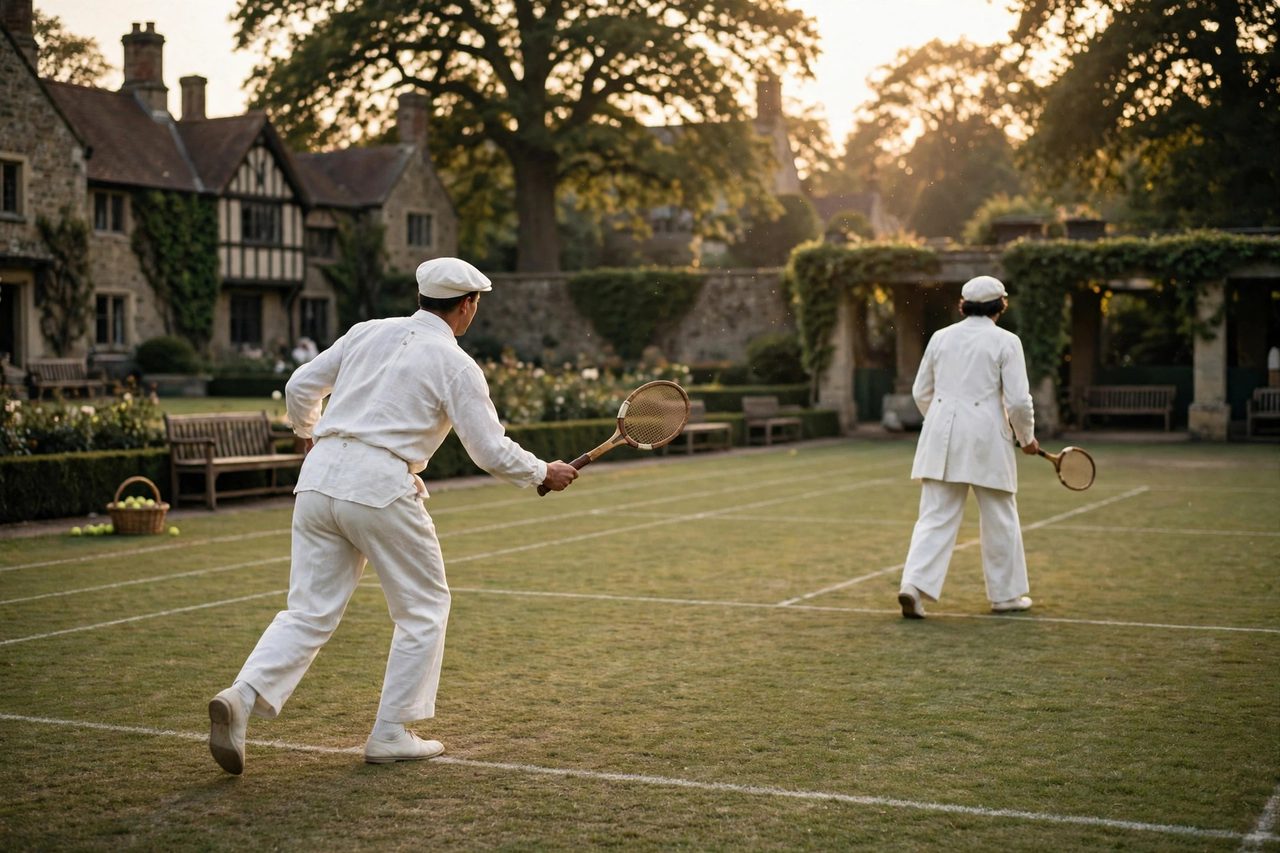
Every tennis fan has had the moment: a friend watching their first match asks why the score goes 15, 30, 40 — and why on earth zero is called “love.” The honest answer is that nobody knows for certain. But the leading theories, pieced together from medieval French court games, tell a story stranger and older than the sport itself.
It started with a clock
The most widely repeated explanation for 15, 30, 40 is the clock face. The ancestor of tennis, jeu de paume — a handball game played in French monasteries and royal courts from the 12th century onward — is thought to have scored points in quarter-hours: 15, 30, 45. A player moved the clock hand around the dial as they won points, and the game was won at 60.
That theory has a problem, of course: the third point is 40, not 45. The usual explanation is that 45 was shortened to 40 for the sake of the umpire’s call — “forty” is quicker and clearer to shout than “forty-five,” and in a game called out loud, brevity mattered. Another theory holds that the scores come not from a clock but from the layout of the old jeu de paume courts, where players moved between lines marked 15, 30 and 40 feet from the net. Either way, the skeleton is the same: quarters of something, counted in fifteens, with the last one trimmed.
What is certain is that the system predates modern tennis by centuries. When Major Walter Clopton Wingfield patented lawn tennis in 1874, he borrowed the scoring of real tennis — the indoor ancestor — wholesale, quirks included. The sport has tweaked almost everything since — racquets, surfaces, tiebreaks, even the serve clock — but it never touched the numbers.
Why zero is “love”
“Love” is the system’s most charming mystery. The most popular theory traces it to the French word l’oeuf — “the egg” — because a zero on a scoresheet looks like an egg. English speakers, the story goes, mangled l’oeuf into “love” over centuries of cross-Channel play. It is a neat story, and linguists are divided on whether it is true: the phonetic jump from l’oeuf to “love” is plausible but not proven.
The rival theory is simpler and more romantic: “love” comes from the phrase “playing for love” — playing for nothing, for the love of the game, when you have no points to show for it. Both theories agree on one thing: tennis is the only major sport that calls nothing “love,” and it has done so for so long that no one alive remembers a time before.
Deuce, advantage, and the refusal to end
The rest of the system is equally medieval. “Deuce” comes from the French à deux — “to two” — because at 40-40 a player must win two points in a row to take the game. “Advantage” is simply what it sounds like: one point of edge, which vanishes if the opponent wins the next point and returns the game to deuce. A game can, in theory, last forever, and before the tiebreak was introduced, so could a set — the 2010 Wimbledon marathon between John Isner and Nicolas Mahut, which ended 70-68 in the fifth set after more than eleven hours, was the last great monument to that refusal to end.
That stubbornness is the point. Tennis scoring was designed for a world without clocks on the scoreboard and without television schedules: a game is not won by reaching a number, but by beating your opponent twice in a row when it matters. The tiebreak, introduced in the 1970s, was a compromise with modernity — a way to end sets without abandoning the system’s soul.
A system that refused to grow up
Modern sports have mostly rationalised their scoring: volleyball went to rally points, cricket simplified its overs, basketball counts in ones, twos and threes. Tennis kept 15, 30, 40 and love, and it kept them for a reason that has nothing to do with logic. The quirks are the sport’s memory. Every time an umpire calls “forty-love,” they are echoing a French monastery court from eight hundred years ago, a clock face, an egg, and a game that was played for love before it was played for money.
That is why the system survives every attempt to modernise it — and why, when your friend asks why the score jumps from 30 to 40, the best answer is not a number. It is a story.
Related articles
The Tiebreak: How Tennis's Greatest Invention Saved the Sport
Before the tiebreak, a tennis set could go on forever. One match lasted three days. This is the story of the man who fixed it — and why the rule is still changing today.

The Ball Kids: Tennis's Smallest, Fastest Stars
They sprint, roll, crouch and vanish — all without a word. Ball kids are the quiet engine of every big tennis match, and getting the job is harder than most people think.
The Sound of Tennis: Grunts, Crowds and the Quiet Rule
Tennis asks its crowds to stay quiet, its players to grunt or not, and every tournament to find its own sound. Here is why the quiet rule exists — and why it keeps being broken.