
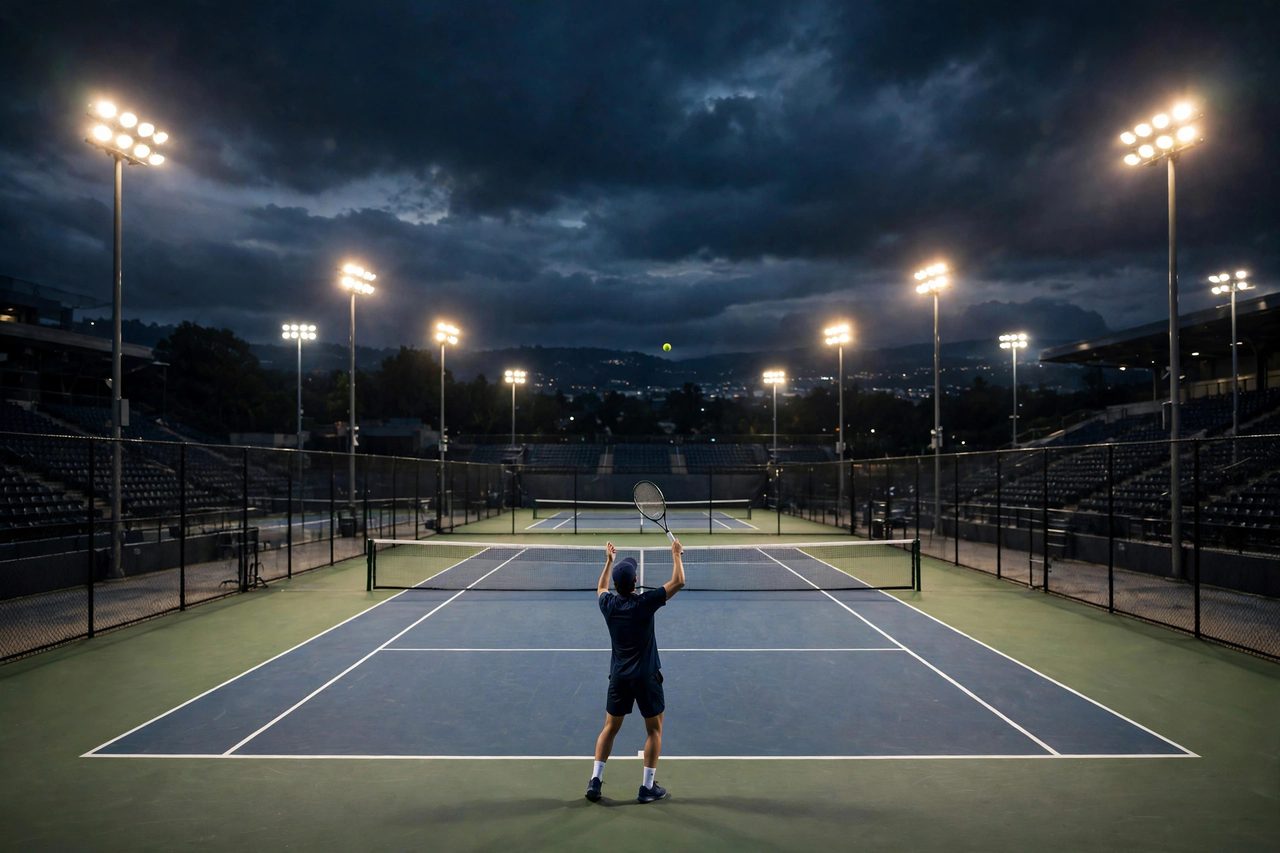
Here is a strange fact about tennis: nobody knows when a match will end. A football match lasts 90 minutes. A basketball game lasts 48 minutes. A tennis match lasts as long as it lasts. It could be over in an hour. It could take five. It ends only when someone wins, and that single quirk shapes everything about the sport.
Where the no-clock rule comes from
Tennis grew out of a French court game called jeu de paume, played with the hand before racquets existed. The scoring system, 15, 30, 40, comes from that old game, and so does the idea that a match is decided by winning points, games and sets, not by a timer.
A game is the smallest scoring unit, won by the first player to four points with a lead of two. A set is a group of games, usually won by the first player to six games with a lead of two. A match is won by the first player to win enough sets, usually two or three. There is no point in the rules where a clock steps in and says time is up.
Early tennis had no time limits because it did not need them. It was a garden-party game for rich amateurs, not a television product. By the time tennis became a professional sport, the no-clock rule was part of its soul. Changing it would have meant changing what tennis is.
Why it makes tennis different
In most sports, a team that is losing can run out of time. The clock is the enemy. In tennis, there is no clock to save you or to kill you. You cannot defend a lead by running down the minutes. You have to win the last point.
That changes everything about how matches feel. A player who is two sets down and facing defeat is not beaten until the final point is lost. Comebacks are always possible, because the match does not end until someone wins it. Some of the greatest matches in history were comebacks that would have been impossible in a timed sport.
It also changes how players think. In football, a team can park the bus, a phrase for defending deep and wasting time to protect a lead. In tennis, there is nowhere to hide. You must keep winning points. Every single point counts, from the first of the match to the last, because there is no moment when the match is safely over before it actually is.
The matches that proved the point
The most famous example is the longest match in history. At Wimbledon in 2010, John Isner of the United States played Nicolas Mahut of France in the first round. The match lasted 11 hours and 5 minutes, spread over three days. The final set alone took more than eight hours. Isner won it 70-68.
A final set is the deciding set of a match. Back then, Wimbledon had no tiebreak in the final set, so the players just kept playing games until someone led by two. They played 138 games in that set alone. The match broke every record and became a global news story, precisely because it refused to end.
Tennis has since added tiebreaks to final sets at the Grand Slams, the four biggest tournaments. Now a final set that reaches 6-6 is decided by a tiebreak, a short game to seven or ten points. The Isner-Mahut marathon will probably never be repeated. But the principle survives: the match still ends only when someone wins it.
The one clock tennis does have
There is one exception, and it is a small one. Tennis has a shot clock. That is a timer that counts down the seconds between points, usually 25 seconds, to stop players taking too long before serving. It keeps the match moving, but it does not decide the winner. It is a speed limit, not a finish line.
Television schedulers hate the no-clock rule. A tennis match can overrun and wreck a broadcast schedule. Tournaments deal with it by starting matches at rough times rather than exact ones, and by accepting that the evening session might start late. Fans have learned to live with it too. You do not plan your evening around a tennis match ending at 9pm. You plan around it ending whenever it ends.
Why fans love it
Ask a tennis fan why they love the sport, and the no-clock rule is often part of the answer. It means every match is a story with an unknown ending. You cannot check the time remaining and relax. You cannot assume a player who is winning will keep winning. The drama lasts as long as the tennis lasts.
It also means the greatest quality in tennis is not speed or strength, but stubbornness. The players who win the most are often the ones who simply refuse to lose the last point. They stay in rallies longer, chase one more ball, and believe that the match is never over until it is over.
Other sports have borrowed bits of tennis. Tiebreaks, sudden-death finishes and golden goals all try to capture the same winner-takes-all feeling. But tennis never needed to borrow it. It had it from the start.
So the next time a tennis match runs long and your evening plans fall apart, remember: that is not a flaw in the sport. It is the sport. Tennis refuses to end on time, and that refusal is exactly what makes it worth watching.
Related articles
The Tiebreak: How Tennis's Greatest Invention Saved the Sport
Before the tiebreak, a tennis set could go on forever. One match lasted three days. This is the story of the man who fixed it — and why the rule is still changing today.

The Ball Kids: Tennis's Smallest, Fastest Stars
They sprint, roll, crouch and vanish — all without a word. Ball kids are the quiet engine of every big tennis match, and getting the job is harder than most people think.
The Sound of Tennis: Grunts, Crowds and the Quiet Rule
Tennis asks its crowds to stay quiet, its players to grunt or not, and every tournament to find its own sound. Here is why the quiet rule exists — and why it keeps being broken.