
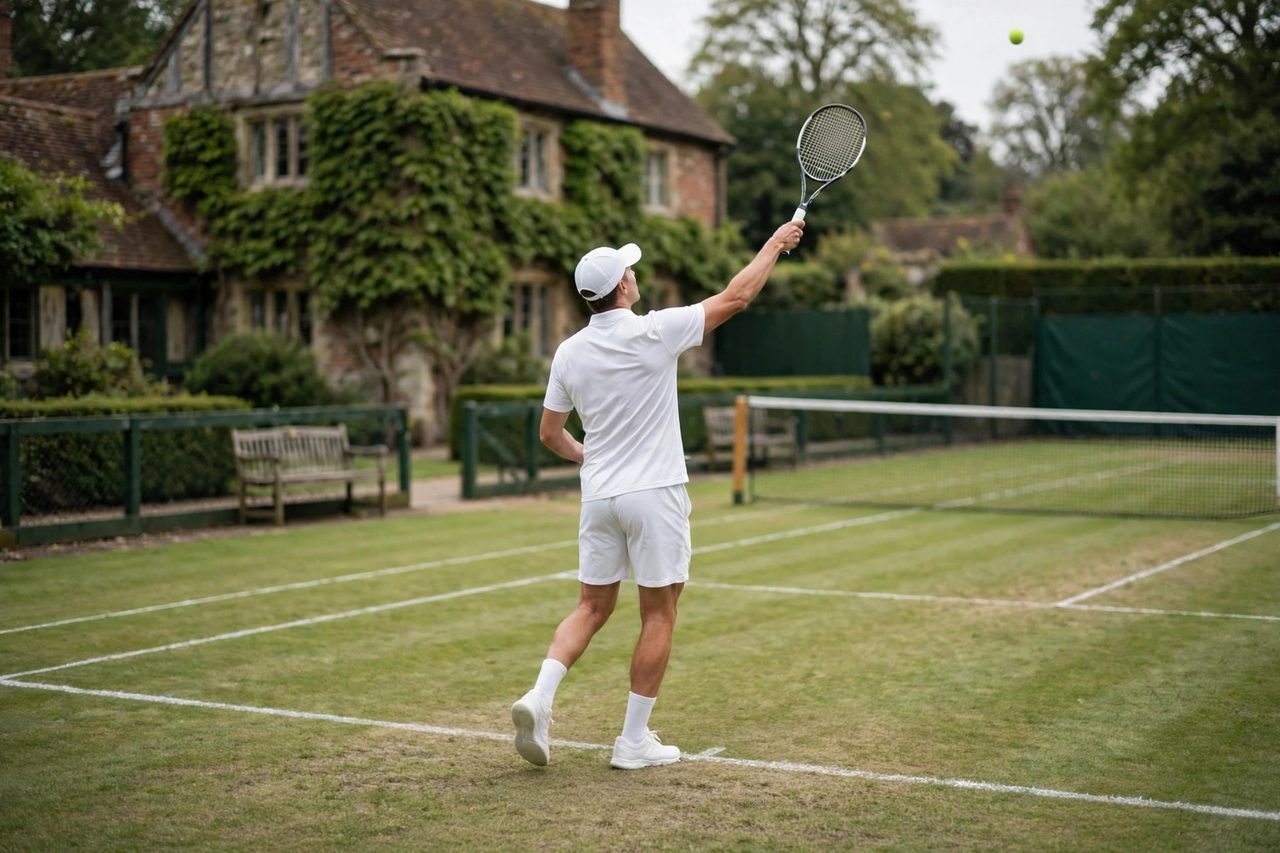
Turn on any other tennis tournament and you will see colour everywhere: neon shirts, bright shoes, bold patterns. Turn on Wimbledon and you will see white. White shirts, white shorts, white skirts, white shoes. Almost everything must be white.
Wimbledon is the only Grand Slam that still demands it. A Grand Slam is one of the four biggest tournaments in tennis: the Australian Open, the French Open, Wimbledon, and the US Open. The other three let players wear whatever they like. Wimbledon does not. So why?
It started with sweat
The rule goes back to the 1800s, to the world tennis was born into. In Victorian England, tennis was a sport for wealthy people, played at garden parties and private clubs. Sweat was considered improper, something a polite person should not show.
White clothing hid sweat better than colour, or at least it showed it less obviously. Dark colours go darker when wet. White stays white, more or less. So players wore white, and the custom stuck.
The first Wimbledon championships took place in 1877. The All England Club, the private club that runs the tournament, kept the white dress code from the start. As tennis grew into a global professional sport, the other tournaments dropped their dress codes one by one. Wimbledon never did.
The rule, in full
Today, the rule says players must wear clothing that is “almost entirely white.” That means shirts, shorts, skirts, dresses, shoes, socks, and even headbands and wristbands. Small touches of colour are allowed, but only a thin trim, no wider than one centimetre, around a collar or a hem.
The rule also covers what you cannot see. Until recently, even underwear had to be white. That changed in 2023, when the club allowed female players to wear dark-coloured undershorts. It was a small change, but an important one, made after players spoke openly about the stress of playing in white during their periods.
Umpires and officials enforce the rule. Players have been told to change mid-tournament. In 2013, Roger Federer was asked not to wear shoes with bright orange soles. In 2017, Venus Williams was told to change her bra strap during a match because it showed pink. Both incidents made headlines, and both showed how seriously Wimbledon takes the rule.
Why it survives
So why does a rule from the 1800s still exist in 2026? There are a few reasons.
First, tradition. Wimbledon sells itself on history. The grass courts, the strawberries and cream, the Royal Box, the lack of sponsor logos on court: it is all part of the same package. The white clothing is the most visible part of that package. Take it away, and Wimbledon looks like any other tournament.
Second, the players mostly like it. Many say there is something special about walking onto Centre Court in all white. It feels different. It feels like Wimbledon. The rule turns the tournament into an occasion, and players rise to occasions.
Third, the rule is now part of the brand. When you see a photo of a player in all white on a grass court, you know instantly it is Wimbledon. No other tournament looks like that. In a sport where every event fights for attention, that instant recognition is worth a lot.
The case against it
Not everyone loves the rule. Critics say it is old-fashioned, and that it puts unnecessary pressure on players, especially women. The 2023 change to undershorts was a step, but some players and fans want the whole rule relaxed, or at least loosened to allow more colour.
There is also the practical side. White gets dirty fast on grass, and players go through multiple outfits during a long match. It is expensive and wasteful in a way that coloured clothing is not.
But every time the rule is questioned, Wimbledon holds firm. The club has tweaked the edges, like the undershorts change, but the core rule has never moved. Almost entirely white, no exceptions, no debate.
A rule that became an identity
Here is the strange thing about the white rule: it started as a way to hide sweat, and it ended up as the most famous dress code in sport. Players who wear colour everywhere else in the year put on white for two weeks in late June and early July, and the whole tennis world watches.
That is why Wimbledon still dresses in white. Not because of sweat anymore, but because of what the white means. It means history. It means tradition. It means this tournament is different from all the others.
And as long as that is true, the white is staying.
Related articles

The Tiebreak: How Tennis's Greatest Invention Saved the Sport
Before the tiebreak, a tennis set could go on forever. One match lasted three days. This is the story of the man who fixed it — and why the rule is still changing today.

The Ball Kids: Tennis's Smallest, Fastest Stars
They sprint, roll, crouch and vanish — all without a word. Ball kids are the quiet engine of every big tennis match, and getting the job is harder than most people think.
The Sound of Tennis: Grunts, Crowds and the Quiet Rule
Tennis asks its crowds to stay quiet, its players to grunt or not, and every tournament to find its own sound. Here is why the quiet rule exists — and why it keeps being broken.