
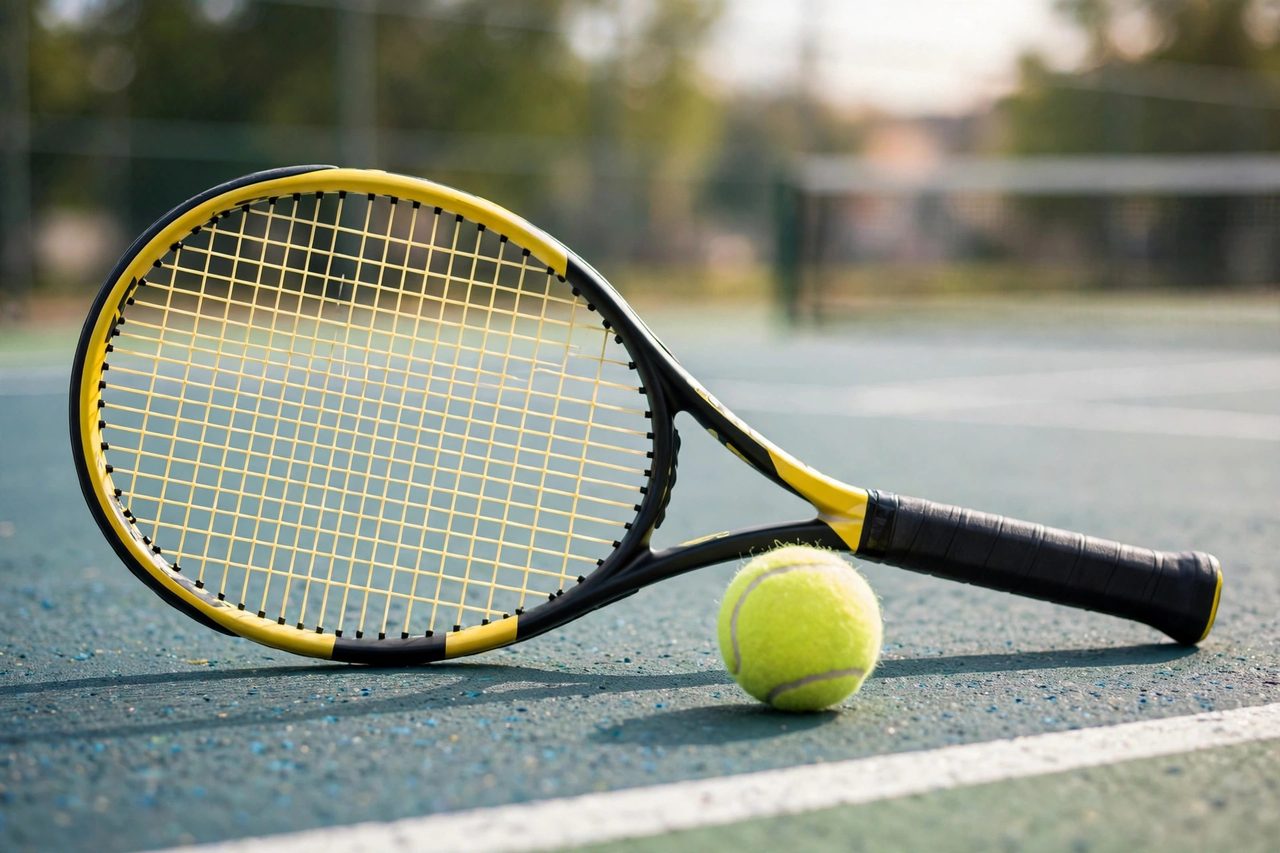
If you like hitting the ball hard and watching it dive down into the court, the Babolat Pure Aero probably already has your attention. It is one of the most famous racquets in modern tennis, and the 2026 version, the ninth generation (Gen 9), keeps the same basic idea: spin first, power second, control third. Here is what it actually offers, and who it is really for.
The key specs
Let us start with the numbers, because they tell you a lot. The Pure Aero weighs 300 grams without strings. That is a solid middleweight frame, heavy enough to feel stable but light enough for most adult players to swing fast.
The head size is 100 square inches. The head is the oval part of the racquet that holds the strings, and 100 square inches is the standard modern size: big enough to be forgiving on off-centre hits, small enough to stay precise.
The string pattern is 16 by 19. That means 16 main strings run up and down, and 19 cross strings run side to side. A more open pattern like this lets the strings move and snap back, which helps create spin. Spin is the rotation you put on the ball, and topspin is the forward rotation that makes the ball drop sharply into the court.
The balance is 320 millimetres, which is slightly head-light. Balance describes where the racquet’s weight sits: head-light means it feels lighter in your hand and quicker to move, even though the total weight is the same. The stiffness rating is 69 RA. Stiffness measures how much the frame bends on impact, and a higher number means a firmer, more powerful feel.
Babolat recommends stringing it between 23 and 27 kilos, and pairs it with its own RPM Blast or RPM Rough strings. The frame also uses flax fibres in key spots. Flax is a plant fibre, and Babolat uses it to soak up vibrations and improve the feel at impact.
What it feels like to play with
On court, the Pure Aero does exactly what it promises. Groundstrokes, the shots you hit after the ball bounces, jump off the strings with heavy topspin. That spin is useful because it lets you swing hard without the ball flying long. The ball dips down late, lands inside the lines, and then kicks up awkwardly for your opponent.
The aerodynamic frame shape helps here too. The beam, the edge of the frame, is shaped to cut through the air more quickly, so you can generate faster racquet-head speed. Faster racquet-head speed means more spin and more pace with the same effort.
Serves get a boost as well. The combination of power and spin makes it easier to hit a serve with kick, the kind that bounces up high and pushes your opponent back. If your game is built around attacking from the baseline, the back line of the court, this racquet will feel like it was made for you.
There is a trade-off, though. This is not a racquet for soft, touch-based tennis. Volleys, the shots you hit before the ball bounces, can feel a little lively and harder to control. If you play a lot of serve-and-volley tennis, charging to the net behind your serve, you may want something with a softer, more controlled feel.
Who should buy it?
The Pure Aero suits aggressive players. If you like to dominate rallies from the back of the court, hit with big topspin, and finish points with pace, this is your racquet. It also suits strong intermediate players who are ready for a proper performance frame and want help generating spin.
It is less suited to beginners. A beginner is better off with a lighter, more forgiving racquet that helps them get the ball over the net first. It is also not the best pick for players with sensitive arms. A stiff frame like this sends more vibration to your arm than a flexible one, so if you have had elbow problems, demo it carefully first.
One practical note: the Pure Aero is sold unstrung. That means it arrives without strings, and you choose your own strings and tension. Tension is how tight the strings are pulled, and it affects power and control. This is good news if you like customising your setup, but it means you need to budget for a stringing job on top of the frame.
The verdict
The 2026 Pure Aero is not a reinvention. It is a refinement of a racquet that already knew what it wanted to be. The tighter string pattern gives a little more control than the previous version, while the spin and power that made the range famous are still there.
If you are an attacking baseliner who wants heavy spin and easy power, this is one of the best racquets you can buy. If you prefer touch, feel and pinpoint control above all else, look at a thinner, more flexible frame instead.
Either way, try before you buy. A racquet is personal. Twenty minutes on court will tell you more than any review can.
Related articles

Wilson Clash 100 v2 Review: The Softest Hitter in Tennis
The Wilson Clash 100 v2 is one of the most comfortable tennis racquets you can buy: a 100-square-inch head, a light 295-gram frame and a soft 57 RA flex. Here are its real specs, how it plays, and who should buy it.
Head Boom MP 2024 Review: Easy Power With a Soft Feel
The Head Boom MP 2024 is a power-first tennis racquet for intermediate players: a 100-square-inch head, a light 295-gram frame and a soft 62 RA flex. Here are its real specs, how it plays, and who should buy it.

Dunlop CX 200 Tour 16x19 Review: Small Head, Big Control
The Dunlop CX 200 Tour 16x19 is a player's racquet with a compact 95-square-inch head, fast swing and classic feel. Here are its real specs, who it suits, and who should look elsewhere.