
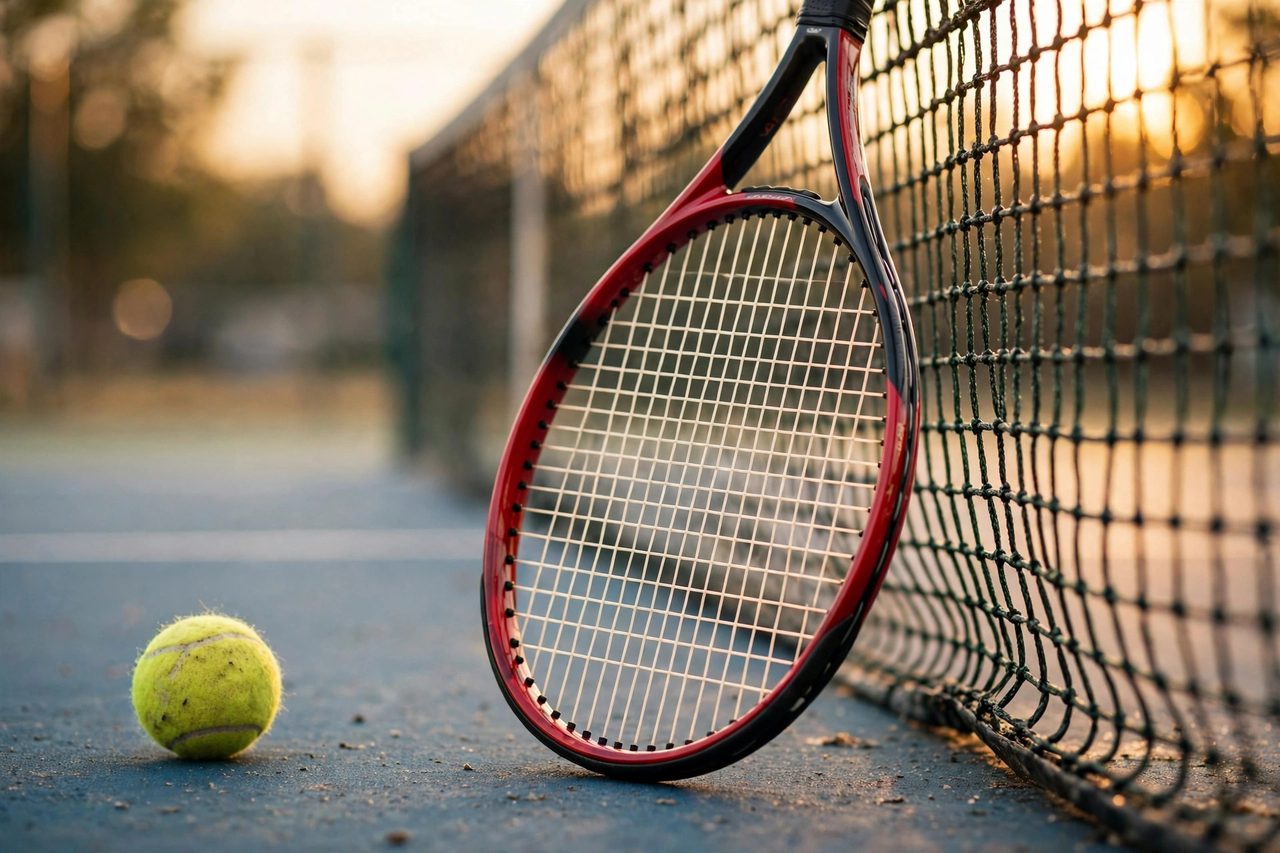
Some racquets feel like a plank of wood. The Wilson Clash 100 v2 feels like a cushion. The first Clash, launched in 2019, was the softest frame on the market, and players with sore arms loved it. This second version, from February 2022, keeps that comfort and adds a little more stability and control — and since the Clash v3 arrived in early 2025, the v2 is often sold at a discount.
Wilson pitches it at intermediate players, but it works for anyone who puts comfort first — it sits mid-range in the Clash family, between the lighter 100L and the heavier 100 Pro and 98.
The key specs
The head size is 100 square inches — the standard modern size for the oval part of the racquet that holds the strings. It gives you a generous sweet spot: the area of the strings where the ball comes off clean and feels good, so off-centre hits lose less pace.
It weighs 295 grams without strings, about 312 grams (11 ounces) once strung: a midweight frame, light enough to swing fast, heavy enough to stay steady against a hard ball.
The balance is 7 points head-light once strung: head-light means more weight sits in the handle than in the head, so the racquet feels quick at the net. The swingweight is 313. Swingweight measures how heavy a racquet feels when you swing it, rather than just holding it, and 313 is fast for a 295-gram frame.
The stiffness rating is 57 RA. Stiffness, on the RA scale, tells you how much the frame bends on impact: lower numbers feel softer and more comfortable, higher numbers firmer and more powerful. At 57, this is one of the softest frames on the market — the first Clash was even softer at 55 RA, but Wilson stiffened the v2 slightly and reinforced the top of the frame for more stability.
The beam — the frame’s thickness — is 24.5 millimetres, on the thicker side, which usually means more free power.
The string pattern is 16 by 19: 16 main strings up and down, 19 cross strings side to side. This fairly open pattern lets the strings move and snap back, and that snap-back helps create spin. Spin is the rotation you put on the ball, and topspin is the forward rotation that makes the ball drop sharply into the court.
Recommended string tension is 50 to 60 pounds. Tension is how tightly the strings are pulled: lower means more power and comfort, higher means more control.
The frame is graphite with Wilson’s FORTYFIVE° technology, a carbon layout that lets it bend in two directions at once, so it flexes with your swing instead of fighting it — it replaced the first Clash’s FreeFlex branding. Launch price was $269 in the US and £250 in the UK, but since the Clash v3 replaced it in early 2025, the v2 is now mostly sold as remaining stock, often for around $200 to $250.
On the court
From the baseline — the line at the back of the court, where most rallies are played — the first thing you notice is the comfort. The ball sinks into the strings and comes off soft, with almost no vibration reaching your hand. If you have ever had tennis elbow — the sore pain on the outside of the elbow from repeated hard impacts — you will feel the difference in five minutes, and a soft frame like this one is the easiest way to keep it away.
The power is easy but not wild. The ball leaves the strings with good depth without a hard swing, and the open 16x19 pattern adds plenty of topspin, so you can swing big and trust the ball to drop inside the lines. Playtesters at Tennis Warehouse hit 4 to 6 mph faster on their groundstrokes than with a stiffer control frame — a groundstroke is a shot you hit after the ball bounces, usually from the baseline.
The trade-off is the launch angle — the path the ball takes off the strings. The Clash sends it up a little higher than most racquets, which helps spin and depth but can send balls long if your timing is off, so you need to trust the spin to bring the ball down.
At the net, the light weight and head-light balance make it very quick. Volleys are shots you hit before the ball bounces, usually close to the net, and they demand fast hands — the Clash gets into position in a hurry. The one weakness is stability: against a really hard ball, the soft frame can twist a little, and the v2 is better than the first Clash here but still not rock solid.
On serve, opinions split: some testers loved the easy power and spin, others wanted more weight behind the ball for a heavy first serve. The quick swingweight helps you generate racquet speed — and racquet speed creates both pace and spin — so kick serves, serves with heavy topspin that bounce high and jump away from your opponent, work well.
Who should buy it
This racquet suits an intermediate player who wants comfort above everything else, especially if your arm or elbow has ever complained. It also suits a player coming back from a break who wants an easy, forgiving frame to rebuild confidence with, and anyone who rallies from the baseline with spin.
Very hard hitters who want pinpoint control should look at the heavier, slightly firmer Clash 98 v2 instead, and maximum-power seekers at a stiffer frame like the Babolat Pure Drive — at the cost of the comfort that makes the Clash special.
The verdict
The Wilson Clash 100 v2 does one thing better than almost any racquet on the market: it is kind to your arm. Easy power, big spin, a fast swing, and a soft feel that keeps tennis fun even when your elbow is not at its best. Control is not pinpoint and the launch angle needs a little trust, but that is a small price to pay — and with the v3 now on sale, the v2 at a discount is one of the best value buys in tennis.
Related articles
Head Boom MP 2024 Review: Easy Power With a Soft Feel
The Head Boom MP 2024 is a power-first tennis racquet for intermediate players: a 100-square-inch head, a light 295-gram frame and a soft 62 RA flex. Here are its real specs, how it plays, and who should buy it.

Dunlop CX 200 Tour 16x19 Review: Small Head, Big Control
The Dunlop CX 200 Tour 16x19 is a player's racquet with a compact 95-square-inch head, fast swing and classic feel. Here are its real specs, who it suits, and who should look elsewhere.
Babolat Pure Strike 2024 Review: The Control Racquet for Players Who Hit Flat and Fast
The fourth-generation Babolat Pure Strike is built for control, precision and feel. We break down its real specs, who it suits, and who should look elsewhere.