
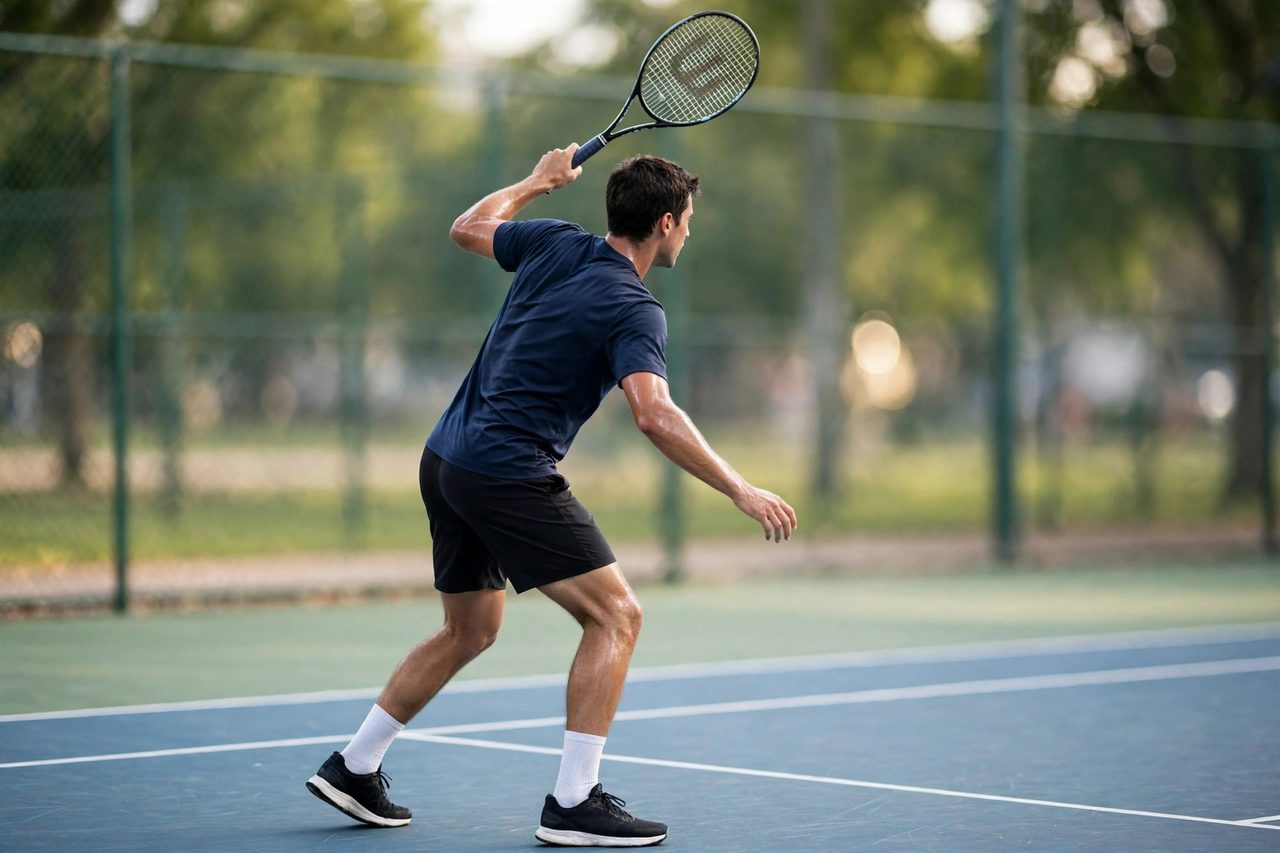
The one-handed backhand is the shot that makes people stop and watch. One arm, one clean swing, and the ball glides across the court. It looks simple. It is not quite simple — but it is very learnable, one step at a time.
A backhand is any shot you hit on the side of your body opposite to your racquet hand. For a right-handed player, that means the left side. A one-handed backhand uses only that one hand on the grip, where a two-handed backhand adds the other hand for support. The one-handed version gives you extra reach and a longer, freer swing. The trade-off is that it asks more of your timing and your shoulder.
You do not need to be strong to hit it well. You need to be on time, and let your body do the work instead of muscling the ball with your arm.
Step 1: The grip
Start with your grip, which is simply how your hand holds the racquet handle. For a one-handed backhand, use the Eastern backhand grip. Hold the racquet out in front of you like you are shaking hands with it, then turn your hand slightly so the base knuckle of your index finger sits on the top edge of the handle. The easy check: with this grip, the strings face your target naturally when you swing, without you having to twist your wrist.
Your other hand rests on the throat of the racquet while you wait. That free hand steadies the racquet, and later it will guide your shoulder turn.
Step 2: Turn your shoulders
As soon as you see the ball coming to your backhand side, turn sideways. This is called the shoulder turn, and it is the most important move in the whole shot. Pivot on your feet so your front shoulder points toward the net post on your backhand side. Your back should be partly facing your opponent.
Most beginners skip this step. They stay facing the net and try to arm the ball across their body. That is why their backhands feel weak and rushed. Turn early, and the shot almost builds itself. Your free hand stays on the racquet throat during the turn, which keeps the swing compact.
Step 3: Take the racquet back, low to high
From your sideways position, let the racquet drop slightly below the height of the incoming ball. The racquet head should sit a little below your waist, with the strings facing down toward the court.
Keep your hitting arm fairly straight but not locked. A straight arm is what gives the one-handed backhand its reach and its classic look. If your elbow bends a lot, you lose that reach and the swing gets cramped.
Step 4: Step in and swing
Step forward with your front foot, toward the ball, as it arrives. Your weight should move from your back foot onto your front foot. This weight transfer is where the power comes from — not from your arm, but from your legs and your body moving forward into the shot.
Now swing, from low to high: brush up the back of the ball. That upward brush creates topspin, which is the forward spin that makes the ball dip down into the court instead of flying long. You do not need a huge swing. A smooth, unhurried swing with good timing beats a wild fast one every time.
Step 5: Contact in front of you
Contact is the moment the strings meet the ball, and for the one-handed backhand it must happen in front of your body — roughly beside your front foot, not beside your back hip. This is the shot’s hardest habit to learn, because it means moving your feet to get into position instead of waiting for the ball to come to you.
If the ball gets past you and you hit it late, beside your body or behind you, the shot will float long or dump into the net. When that happens, do not swing harder. Move your feet earlier next time. Good backhands are won with footwork, not force.
Step 6: Follow through high
The follow-through is what your swing does after contact. Let the racquet keep travelling up and across your body, finishing high, roughly at shoulder height, with the strings facing the sky.
A full follow-through is not decoration. It is proof that you swung through the ball instead of poking at it. If your racquet stops dead at contact, you slowed down too soon, and the ball will lack pace and spin.
Common mistakes
Hitting late. This is number one by a mile. The fix is to turn sooner and move your feet. If you are often late, stand a little further back to buy yourself time while you learn.
Swinging only with the arm. If your shoulder turn is missing, your backhand will feel weak no matter how hard you swing. Turn sideways first, every time.
Dropping the racquet head too far. A big loop looks stylish but makes timing harder. Keep the take-back compact, just below ball height.
Opening the strings at contact. If your wrist flops open, the ball sails long. Keep the wrist firm and the strings slightly closed.
Two drills that actually help
Shadow swings. Without a ball, practise the full motion on an empty court: turn, loop, step, swing, finish high. Ten slow, correct swings beat fifty rushed ones.
Fed balls from a partner. Have a partner toss balls gently to your backhand side, one at a time. Focus only on contact in front of your body. Do not worry about power at all.
Be patient with it
The one-handed backhand takes longer to feel natural than the two-handed version. That is normal. Give it a few weeks of regular practice before judging it. When it clicks — the turn, the step, the clean contact, the high finish — you will understand why so many players refuse to give it up.
Related articles
The Split Step: Tennis's Smallest Move That Changes Everything, Step by Step
The split step is a tiny hop you make just as your opponent hits the ball, and it is the reason good players always seem to be in the right place. This guide explains what it is, when to do it, and how to learn it.
The Approach Shot: How to Come to the Net and Finish the Point, Step by Step
The approach shot is the ball that carries you from the back of the court to the net, so you can finish the point up close. This guide explains when to hit it, how to move, where to aim, and the simple drills that make it work.

The Lob: Tennis's Rescue Shot, Step by Step
The lob is the high, arcing shot that sails over your opponent's head and buys you time. This guide explains when to use it, how to hit it, and the simple drills that make it reliable.