
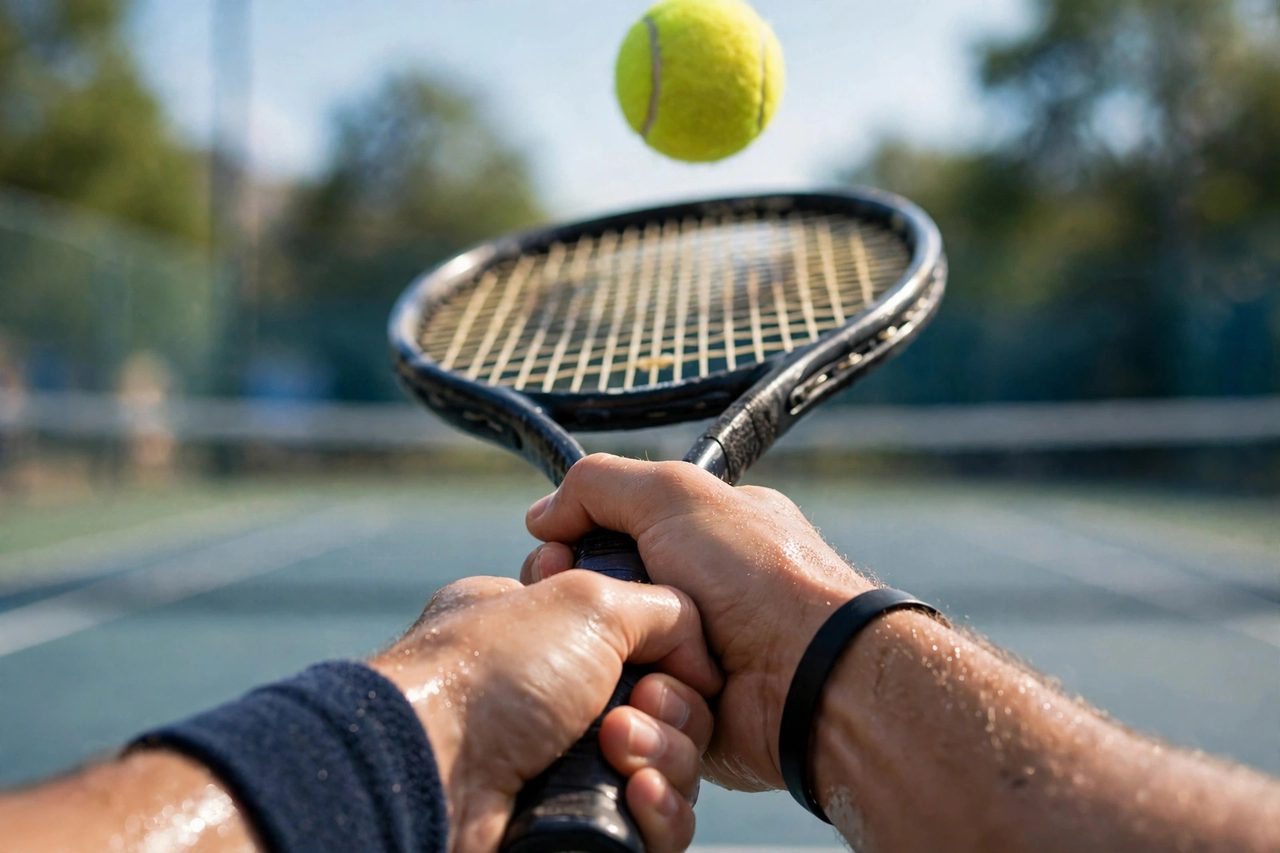
Every club player knows the topspin backhand. Fewer own the slice — and those who do own one of tennis’s great cheat codes. A good slice stays low, skids through the court, buys you time when you’re out of position, and gives aggressive opponents absolutely nothing to work with. Steffi Graf built a dynasty on it. Here’s how to build yours.
The grip
Start with a continental grip — the same grip you’d use for a volley, a serve, or an overhead. Lay the base knuckle of your index finger on bevel two (the top-right slant of the handle for a right-hander), as if holding a hammer you’re about to tap a nail with. The continental grip is non-negotiable for the slice: it presents the strings at the slightly open angle the shot needs. If you’re still holding an eastern backhand grip from your topspin days, the slice will launch.
The preparation
Turn early — the slice is a shot for when you’re rushed, so preparation can’t be rushed. As the ball comes, rotate your shoulders so your chest points toward the side fence and take the racquet back high, above shoulder level, with the racquet face slightly open to the sky. Think of the takeback as short and high rather than big and loopy; the slice works on compactness. Keep your hitting shoulder tucked under your chin and your weight loading onto your back foot.
The contact
This is where the slice lives or dies. Swing forward and slightly downward, cutting under the ball so the strings brush from high to low across its lower half. Contact should be slightly in front of your body, with the racquet face angled just open — not laid flat to the sky (that’s a floater) and not closed (that’s a mishit). The feeling is of carving the underside of the ball, like slicing through a piece of fruit. Your weight transfers forward onto your front foot through contact, and your knees stay bent — the slice is hit from a stable, athletic base, never from a straight-legged reach.
Depth comes from the legs, not the arm. If your slices keep dropping short, the fix is almost never a bigger swing — it’s more knee bend and a firmer drive through the legs.
The follow-through
Finish high and long. After contact, let the racquet continue forward and up, finishing with the elbow pointing roughly at your target and the racquet head finishing around shoulder height or above. A short, stabbing finish produces a short, floating ball; a long, confident finish produces the low, skidding slice that stays down after the bounce.
When to use it
The slice is the ultimate utility shot. Use it:
- On defense — stretched wide or jammed, the slice buys you recovery time because it floats longer and stays low.
- On the approach — a deep, biting slice forces a low reply and gives you time to move in behind it.
- On the return — against big servers, the slice lets you block the return deep without needing a full swing.
- As a change-up — five topspin backhands then one slice at the feet changes the rally’s geometry and breaks an opponent’s rhythm.
The five mistakes that ruin it
- Too open a racquet face. The classic beginner slice launches off the back fence. Close the face until the ball stays under control.
- Chopping straight down. The swing is high-to-low across the ball’s path, not a karate chop. Forward first, down second.
- Standing too upright. Straight legs, short ball. Bend the knees.
- Contact too late. Behind the body, the slice has no leverage. Take it slightly in front.
- Decelerating. The great irony: players slow down on the shot they’re afraid of. Commit to the swing — a firm slice stays low, a tentative one floats.
The one drill that fixes everything
Stand at the baseline and have a partner feed balls to your backhand. Hit ten slices aiming for a target zone two meters inside the baseline, focusing only on knee bend and a long finish — no pace target. Then have the partner alternate deep topspin feeds (defense: get it back low) and short balls (approach: slice and follow it in). Ten minutes of this, twice a week, and within a month you’ll have a shot that changes how people play against you.
The slice is never going to be the shot that wins you points outright. It wins you time, position, and patience — and in tennis, those are the same thing.
Related articles
The Split Step: Tennis's Smallest Move That Changes Everything, Step by Step
The split step is a tiny hop you make just as your opponent hits the ball, and it is the reason good players always seem to be in the right place. This guide explains what it is, when to do it, and how to learn it.

The Approach Shot: How to Come to the Net and Finish the Point, Step by Step
The approach shot is the ball that carries you from the back of the court to the net, so you can finish the point up close. This guide explains when to hit it, how to move, where to aim, and the simple drills that make it work.
The Lob: Tennis's Rescue Shot, Step by Step
The lob is the high, arcing shot that sails over your opponent's head and buys you time. This guide explains when to use it, how to hit it, and the simple drills that make it reliable.