
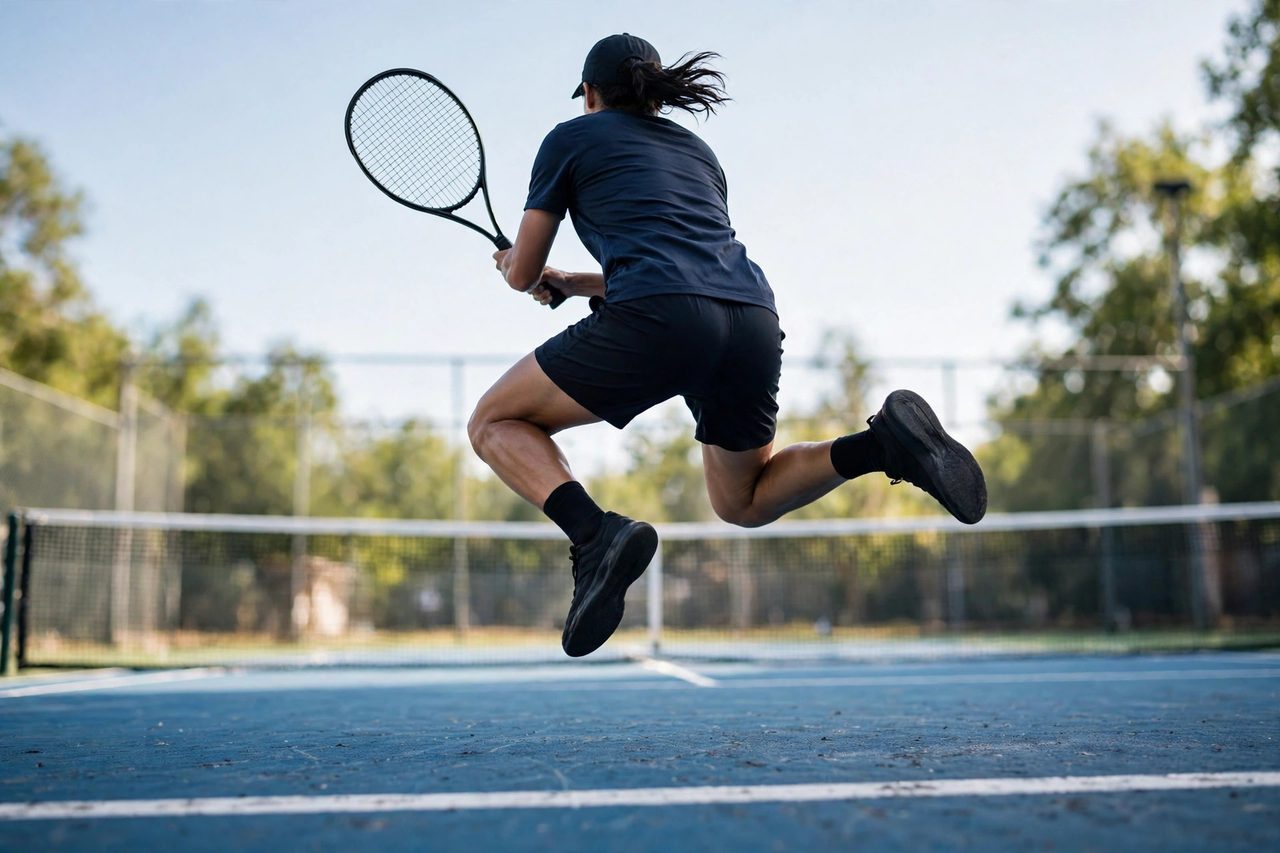
Watch a good player between shots and you will see the same small move every time: just as their opponent hits the ball, they make a little hop onto both feet, land with bent knees, and push off in whatever direction the ball goes. That hop is the split step: a small jump onto both feet at once, timed to the moment your opponent hits the ball, so you land balanced and ready to move. It looks like nothing. It changes everything.
The split step starts almost every move in tennis. Without it, you react late; with it, you are already moving when the ball comes your way.
Why such a small hop matters so much
Tennis is fast. From the moment your opponent hits the ball, you have about a second to read where it is going, move, and get set. Standing flat-footed, that second is gone before you start.
The split step fixes that. Land on both feet with your knees bent, and your muscles are loaded like a spring. You can push off in any direction, because you are not leaning one way already. You land on the balls of your feet — the front part of your foot, just behind your toes — where quick movement starts. It keeps you balanced too, so you arrive with time to hit a clean shot instead of a desperate lunge.
When to do it
Do it every time your opponent is about to hit the ball — no matter where you are on the court, split step as they swing.
Timing takes practice: land just as your opponent makes contact, or a fraction of a second after. Too early and you are stuck waiting; too late and the ball is already past you. Watch their racquet, not the ball — the swing tells you when contact is coming.
It matters most in three moments: waiting at the baseline, which is the line at the very back of the court; at the net, where a volley — a shot hit before the ball bounces — gives you even less time; and after every shot, as you recover to the middle.
How to do it, step by step
Step 1: Get into your ready position
Stand with your feet about shoulder-width apart, knees bent, weight on the balls of your feet, racquet up in front of you. This is your ready position — the balanced stance you return to between shots. Planted heels mean you are too flat-footed to move fast.
Step 2: Watch your opponent’s swing
As your opponent starts to swing, stay light on your feet and keep your eyes on their racquet and the ball. Do not guess where the ball is going yet — a wrong first step is worse than a slow one.
Step 3: Hop as they hit the ball
Just before contact, hop straight up a few centimetres. Both feet leave and land together, about shoulder-width apart. A big jump wastes time in the air, and you cannot move while you are up there.
Step 4: Land soft, knees bent
Land on the balls of your feet, knees bent, weight even. Think of landing like a cat: quiet, soft, and ready to spring, racquet up in front of you. This is the loaded position — the whole point of the move.
Step 5: Push off toward the ball
As soon as you see where the ball is going, push off hard with the foot on the opposite side: ball to your right, push off your left foot; ball to your left, push off your right foot. Take a big first step, then smaller, quicker steps as you get close. Arrive early, set your feet, and hit — then recover to the middle and split step again. One split step per shot, every rally, every point, until it is automatic.
Common mistakes, and how to fix them
Jumping too high is the most common mistake. A big hop keeps you in the air too long, and you land late. Keep the hop tiny — if someone watching can barely tell you left the ground, you are doing it right.
Landing flat-footed is the second mistake. If your heels hit the ground first, your weight sinks back and you cannot push off. Land on the balls of your feet, knees bent, and stay light.
Split stepping too early is the third mistake. If you hop before your opponent even starts their swing, you land and stand still again. Wait for the swing — the hop is timed to the hit, not to the rally. And do not forget it when you are tired: the split step is the first thing to go when your legs get heavy, and that is exactly when you need it most.
Simple practice drills
You can build the split step in 15 minutes.
Start with the shadow drill, on your own. Stand at the baseline in your ready position and imagine your opponent hitting the ball. Hop, land, push off to one side, then walk back and repeat. Do 10 hops to the right, 10 to the left, and 10 forward. No ball needed.
Next, try the call-out drill with a partner. Your partner stands at the net and tosses a ball to your left or right, calling the direction as they release it. Split step on the call, then run to catch the ball after one bounce. This trains the timing: hop, land, then move.
Finally, play the split-step rally. Rally with a partner from the baseline, and make a rule: you must split step before every shot your partner hits. After 10 minutes, you will feel the difference: you arrive earlier, and your shots feel calmer. That is the split step doing its job.
It is a tiny move that never makes the highlight reel — but it is the move that lets you reach the balls you used to watch go past. Practise it until you stop thinking about it, and every other part of your game gets easier.
Related articles

The Approach Shot: How to Come to the Net and Finish the Point, Step by Step
The approach shot is the ball that carries you from the back of the court to the net, so you can finish the point up close. This guide explains when to hit it, how to move, where to aim, and the simple drills that make it work.
The Lob: Tennis's Rescue Shot, Step by Step
The lob is the high, arcing shot that sails over your opponent's head and buys you time. This guide explains when to use it, how to hit it, and the simple drills that make it reliable.
The One-Handed Backhand, Step by Step
The one-handed backhand looks like the prettiest shot in tennis. It also feels great when you get it right. Here is how to build it from the grip up — turn, swing, contact, follow-through, plus the mistakes to avoid and drills that actually help.