
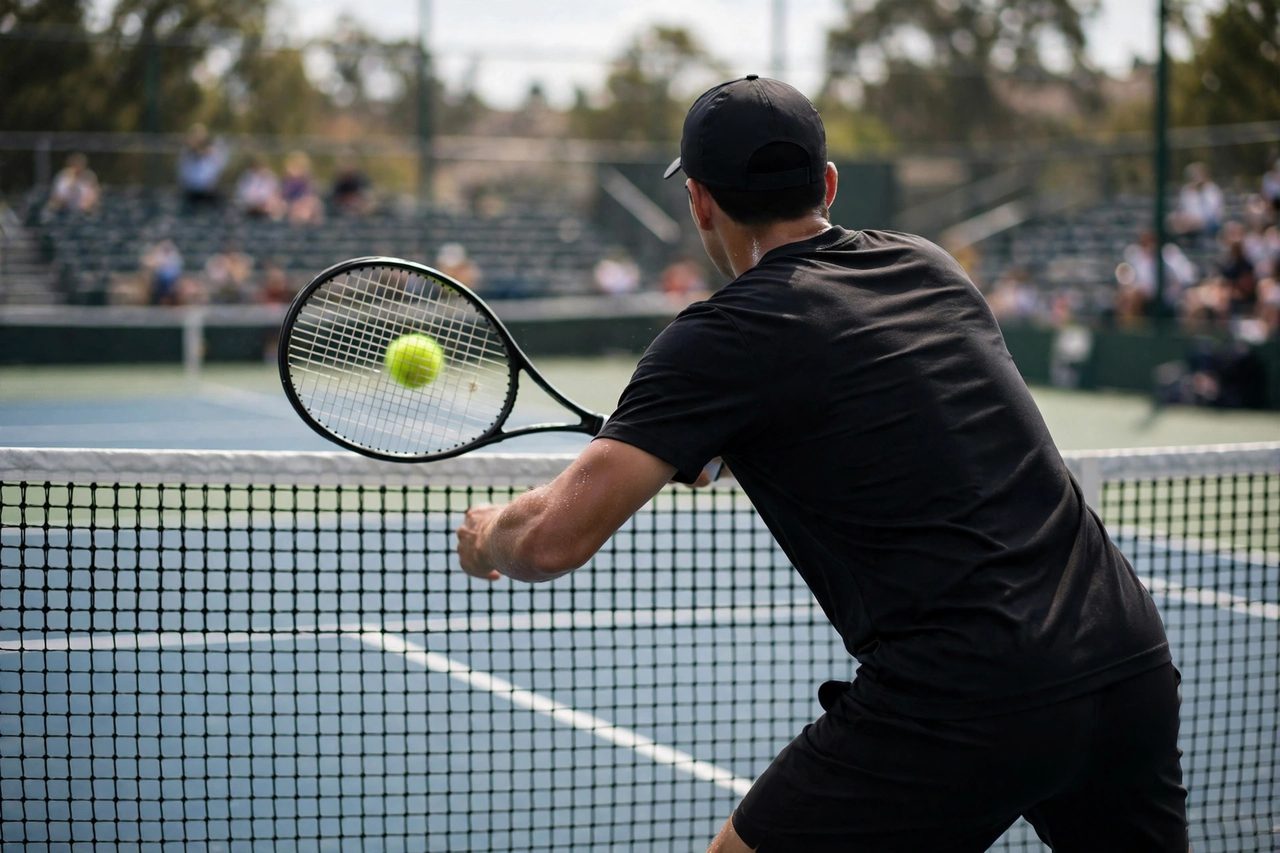
The volley is one of the most satisfying shots in tennis. It is the shot you hit before the ball bounces, usually when you are close to the net. A good volley ends the point fast. A bad volley can feel awkward. The good news is that the volley is simpler than it looks. You do not need a big swing. You need good position, a firm wrist, and a short, calm movement.
Here is the volley, step by step.
Step 1: Get the right grip
Your grip is how you hold the racquet. For the volley, use the continental grip. To find it, hold the racquet as if you were shaking hands with it. The base knuckle of your index finger, the knuckle closest to your hand, should sit on the top edge of the handle.
The continental grip works for both forehand and backhand volleys. That is a big help. You do not need to change your grip in the middle of a fast exchange at the net. Just keep the same grip, and let your feet and body do the work.
Step 2: Get ready early
As your opponent is about to hit the ball, get into a ready position. Stand with your feet about shoulder-width apart, knees slightly bent, and weight on the balls of your feet. Hold the racquet out in front of your body, with the head, the round top part, up and slightly above your hands.
Keep the racquet still. A common beginner mistake is to wave the racquet around while waiting. That wastes time. Hold it steady in front of you, and you will react faster.
Step 3: Move, do not reach
When the ball comes towards you, move your feet first. Take small, quick steps to get your body behind the ball. Do not just stretch your arm out. Reaching makes the volley weak and hard to control.
For a forehand volley, a shot on the same side as your racquet hand, step forward with your left foot if you are right-handed. For a backhand volley, a shot on the opposite side, step forward with your right foot. This is called stepping into the shot. It puts your body weight behind the ball, so the volley has pace without a big swing.
If the ball is wide, use a side step or a crossover step to get there. The key rule is simple: feet first, racquet second.
Step 4: Keep the swing short
This is the most important part. A volley is not a groundstroke. A groundstroke is a shot hit after the ball bounces, with a full swing. A volley uses a short, punchy movement.
Take the racquet back only a little, maybe 30 centimetres. Then push it forward through the ball, as if you were catching the ball on the strings and guiding it over the net. Keep your wrist firm. A floppy wrist makes the racquet twist, and the ball goes anywhere.
Think of the volley as a block, not a hit. The ball already has pace from your opponent. You just need to redirect it, with control.
Step 5: Meet the ball in front
Hit the ball in front of your body, not beside it. If the ball gets past you, it is too late to volley well. That is why footwork matters so much. Get your body to the ball, so contact happens out in front, where you can see it clearly.
Keep your racquet head slightly above your hands at contact. This helps the ball travel slightly downwards, over the net and into the court. If your racquet head drops below your hands, the ball tends to pop up, and your opponent can attack it.
For a low volley, a ball that arrives near your feet, bend your knees more. Do not bend at the waist and drop the racquet head. Stay low with your legs, keep the racquet up, and push through the ball. Low volleys are hard, so do not panic if they go wrong at first. They improve with practice.
Step 6: Aim small, then recover
Beginners should aim for big, safe targets. Aim crosscourt, diagonally across the court, and aim deep, near the back of the service box. The service box is the smaller rectangle near the net, marked by the service line. Deep volleys push your opponent back and give you time.
After you hit the volley, recover quickly. Step back into a ready position, racquet up, feet moving. A good volley often comes back, and you need to be ready for the next ball. Net play is a chain of small movements, not one big shot.
Common mistakes, and how to fix them
Swinging too big is the number one mistake. If your volleys fly long, shorten your swing. Think block, not swing.
Reaching instead of moving is the second mistake. If you feel stretched, your feet were late. Next time, take one more small step before you hit.
A soft wrist is the third mistake. If the racquet twists in your hand, grip a little firmer and keep your wrist steady through contact. You do not need to squeeze hard all the time, just firm at the moment of impact.
A simple practice plan
You can practise the volley with a partner in 15 minutes. Stand at the service line, the line that marks the front of the service box, and have your partner feed you gentle balls from the baseline. Focus on short swings and stepping in. Do 20 forehand volleys, then 20 backhand volleys, then mix them up.
Then move a little closer to the net and repeat. Closer means faster reactions, so start further back and move in only when you feel comfortable. Finish with a simple game: first to 10 points, where every point must end with a volley. It is fun, and it teaches you to stay calm at the net.
The volley is not about power. It is about position, timing, and a firm, short movement. Get those right, and the net becomes a fun place to be, not a scary one. Start with a short swing, move your feet, and let the ball come to you. The rest will follow.
Related articles

The Split Step: Tennis's Smallest Move That Changes Everything, Step by Step
The split step is a tiny hop you make just as your opponent hits the ball, and it is the reason good players always seem to be in the right place. This guide explains what it is, when to do it, and how to learn it.

The Approach Shot: How to Come to the Net and Finish the Point, Step by Step
The approach shot is the ball that carries you from the back of the court to the net, so you can finish the point up close. This guide explains when to hit it, how to move, where to aim, and the simple drills that make it work.

The Lob: Tennis's Rescue Shot, Step by Step
The lob is the high, arcing shot that sails over your opponent's head and buys you time. This guide explains when to use it, how to hit it, and the simple drills that make it reliable.