
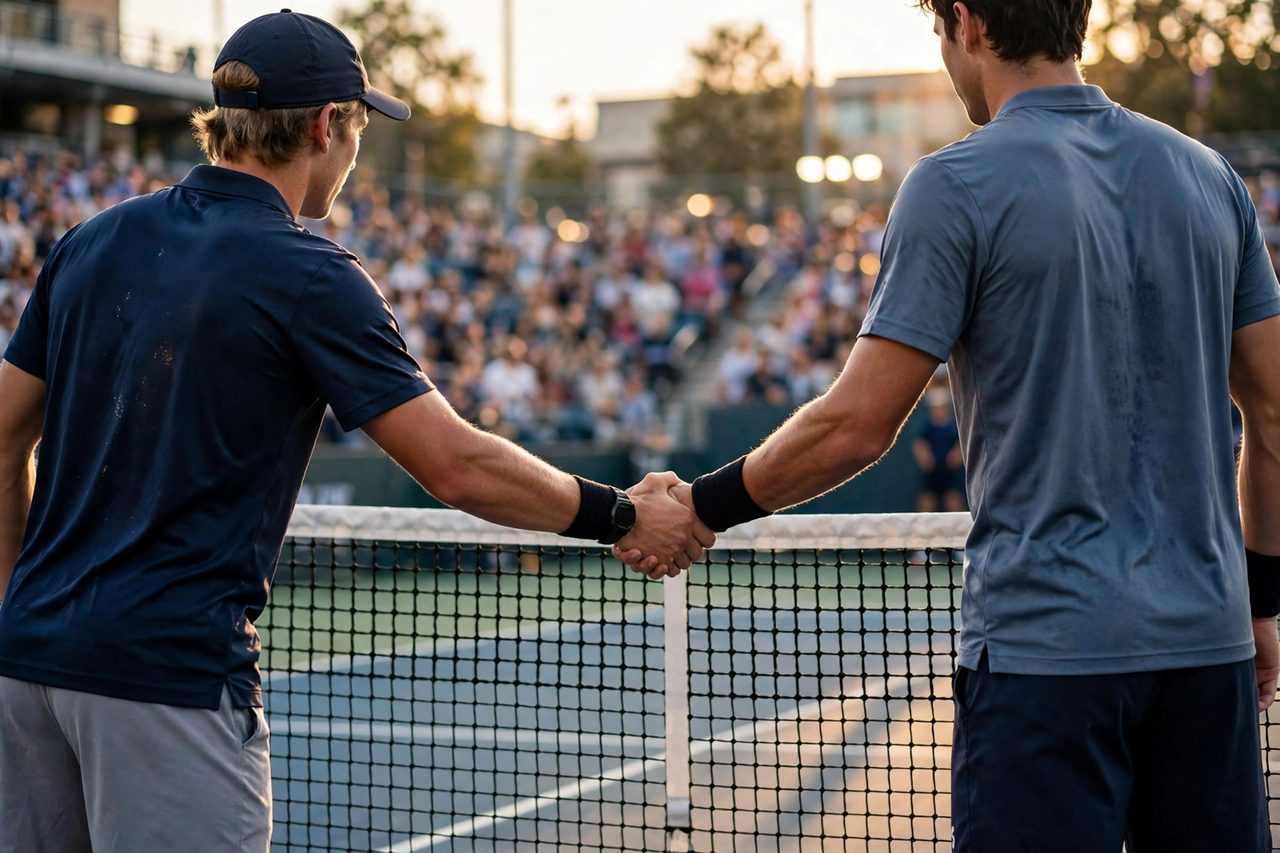
Every great era in tennis ends the same way: with a worry. When Federer, Nadal and Djokovic finally began to leave the stage, the fear was not that the sport would lack champions — it was that it would lack a story. Tennis runs on rivalries, on the promise that the two best players in the world will keep meeting in finals and keep raising each other. For a while, nobody knew who the next pair would be. The answer turned out to be unusually simple: Carlos Alcaraz and Jannik Sinner, who have not so much succeeded the Big Three as re-founded the sport between the two of them. They have played 17 times. Alcaraz leads the series 10-7. Almost none of it has been ordinary — and lately almost all of it has been for trophies, with their last eight meetings all coming in finals.
The most telling statistic is also the simplest. Since the start of 2024, every Grand Slam title in men’s tennis has gone to one of these two men — nine majors in a row, split five to Alcaraz and four to Sinner within that run, and seven in total for the Spaniard against four for the Italian. Two players, two years apart in age, have turned the top of the game into a private conversation, and the rest of the tour is currently listening through the wall.
How the takeover happened
Sinner, born in 2001 in South Tyrol, in the German-speaking north of Italy, arrived first as a prospect and later as a finished product. Alcaraz, born in 2003 in Murcia, Spain, arrived like a weather event. He won the 2022 US Open at nineteen and became the youngest world number one in the history of the men’s rankings, a teenager holding a trophy that was supposed to take years to reach. Sinner’s climb was slower and more methodical — then, at the end of 2023 and into 2024, it suddenly was not. He won the 2024 Australian Open, his first major, beating Djokovic in the semi-final on the Serb’s own favourite court, and finished that year as world number one.
The two had been circling each other since their first meeting in Paris in 2021, which Alcaraz won, and their early matches already had a reputation among other players. Their 2022 US Open quarter-final — five sets, finished close to three in the morning, one rally of such sustained violence that both men ended up on the floor — is still talked about as a glimpse of the game’s future arriving early. Alcaraz won it and went on to take the title. The rivalry was real before either of them had fully become himself.
The year 2023 belonged to them in halves, even though Djokovic still owned its ending. Alcaraz beat the Serb in a five-set Wimbledon final that announced, as clearly as a result can, that the old order’s lease was expiring. Sinner, meanwhile, won his first Masters 1000 title in Toronto and then carried Italy to the Davis Cup, beating Djokovic twice in one day in the semi-finals — once in singles, once in doubles — in the kind of weekend that turns a prospect into a leader. By the time Sinner dismantled the field at the 2024 Australian Open, the two storylines had merged into one: the future had two names, and they were already keeping each other’s phone numbers busy. Their three meetings in 2024 all went to Alcaraz, and all three were arguments in miniature — a comeback from a set down at Indian Wells, a five-set semi-final at Roland-Garros, and a Beijing final of nearly three and a half hours settled in a third-set tie-break. Sinner was winning more matches against the rest of the tour than anyone alive. Against Alcaraz, he could not yet win the ones that ached.
What turned a promising duel into a takeover was 2024 and 2025, when the pair stopped sharing the sport with anyone. Djokovic, in his late thirties, could still ruin a draw — he beat Alcaraz at the 2025 Australian Open — but he could no longer hold the centre. Alexander Zverev, Daniil Medvedev and Taylor Fritz all reached major finals in this period; all of them discovered the same arithmetic. To win a Grand Slam now, you had to go through Alcaraz, Sinner, or, in the cruel version, both of them back to back.
2025: the year of three finals
If one season defines the rivalry so far, it is 2025, when Alcaraz and Sinner met in the finals of Roland-Garros, Wimbledon and the US Open — the first pair in the Open Era to contest three major finals in the same year. Each match rewrote the terms of the argument.
Paris came first, and produced the masterpiece. Sinner, returning that spring from a three-month suspension in an anti-doping case that had dominated the sport’s conversation, had powered through the Rome final (lost to Alcaraz) and the Paris draw without dropping a set. In the final he led by two sets, then held three championship points on Alcaraz’s serve in the fourth. Alcaraz saved all three, won the fourth set in a tie-break and the fifth in another, after five hours and 29 minutes — the longest Roland-Garros final ever played. It was the kind of escape that usually decides a rivalry’s mythology for a decade.
Five weeks later at Wimbledon, Sinner answered in the most Sinner way imaginable: no drama, no visible emotion, just a four-set dismantling of the two-time defending champion on Centre Court. Then, in New York, Alcaraz answered the answer, winning the US Open final in four sets with the most complete performance of their series — and joking, trophy in hand, that he was now seeing Sinner more often than his own family. Across the three finals the level never dipped below extraordinary, and the stylistic contrast that makes the rivalry sing was on full display.
Fire against ice
Alcaraz plays tennis the way a gifted improviser plays music — by ear, at speed, in public. His game is built on violent acceleration: a forehand that can be hit from anywhere, drop shots disguised until the last flicker, kicks and sprints and sliding retrievals that turn defensive points into highlight reels. He grins mid-rally. He cups his ear to the crowd. He goes for the impossible shot at 30-30 in the fifth and seems genuinely unsurprised when it lands. Coaches call it variety; what it really is, is optionality. On any given point Alcaraz has more ways to win it than the man across the net, and his opponents know it.
Sinner is the opposite kind of frightening. A junior ski champion as a boy — the balance and the economy of movement still show — he plays with a calm that borders on the eerie, hitting groundstrokes of a purity and depth that pin opponents behind the baseline and slowly remove their choices. Where Alcaraz improvises, Sinner systematises. His serve, once the weak point of his game, was rebuilt into a weapon; his return and his backhand down the line are among the most reliable shots in modern tennis. He rarely looks hurried, rarely looks thrilled, and after beating Alcaraz has sometimes barely looked up. Between them they cover the whole emotional range of sport: the showman and the surgeon.
Their head-to-head reflects the surfaces as much as the men. Alcaraz leads their meetings at the majors 4-2 and has the edge outdoors on hard courts and clay; Sinner has never lost to him on grass, winning both their Wimbledon meetings. Sinner has also owned the season’s indoor finale, winning the ATP Finals in Turin in 2024 and again in 2025, the second time against Alcaraz in the final — the Spaniard has still never won that event. And in the spring of 2026 Sinner won their only meeting of the year, in the Monte Carlo final, which means the Italian takes a two-match winning streak into whatever comes next.
Like all the durable rivalries, this one is really a collaboration in improvement, conducted at gunpoint. Sinner’s serve was rebuilt because standing still against Alcaraz’s returns was untenable. Alcaraz, beaten at Wimbledon in 2025 by an opponent who simply out-served and out-steadied him, arrived in New York weeks later with a remodelled delivery of his own and produced the most commanding serving run of his career. Neither man can afford a weakness the other has seen twice, because the other will build an entire game plan around it and bring it to a final. It is the same engine that drove Federer, Nadal and Djokovic upward for twenty years, installed in two new machines.
The crown changes shoulders
Woven through the titles is a second contest, for the number one ranking, and it has swung like a pendulum. Alcaraz got there first, in 2022, at an age when most players are still learning how to lose properly. Sinner took the ranking in 2024 and held it with a metronome’s steadiness through his run of hard-court dominance, finishing that year on top. Alcaraz’s US Open title in 2025 pulled the ranking back to Spain. Neither man has yet managed a full calendar year of undisputed ownership; the crown keeps changing shoulders, which is precisely what a rivalry is supposed to do to a crown.
Early 2026 supplied the rivalry’s latest landmark. At the Australian Open, Alcaraz finally won the one major missing from his collection, completing a career Grand Slam at 22 — younger than any man in history had managed it — and taking his total to seven majors. It also extended the pair’s monopoly: nine consecutive Grand Slam titles between them, stretching back two full years, a run of shared dominance the sport has not seen since the middle of the Big Three era.
And yet the most remarkable thing about the rivalry in 2026 was its absence. Injuries interrupted both men’s seasons, meetings became rare, and the tour briefly remembered what life without them looked like: worthy, varied, and noticeably quieter at the very top. It clarified something the sport had half-suspected. This is no longer a rivalry the tour happens to have. It is the load-bearing structure of men’s tennis.
Why the sport needed exactly this
Context is everything. The Big Three did not just win; they monopolised meaning in men’s tennis for twenty years, and a generation of excellent players — the Zverevs, Medvedevs and Tsitsipases of the world — spent their primes as supporting cast. When the end came, the danger was a splintered era: a dozen good players trading majors, none of them great, the sport’s centre of gravity dissolving into the calendar. That is not a snobbish concern. Rivalries are how tennis explains itself to the world, and finals between all-time talents are its flagship product.
Alcaraz and Sinner solved the problem almost suspiciously perfectly. They are close in age, so the duel can run a decade. They are opposite in temperament, so every match is a story about identity as much as technique. They are both, crucially, complete players with no surface to hide on — the rivalry works in Melbourne, Paris, London and New York alike. And they keep producing the one thing no marketing department can manufacture: matches people will describe to their grandchildren. Paris 2025 is already in that category.
The numbers will take care of themselves. Alcaraz’s seven majors at 23 put him ahead of the Big Three’s pace at the same age; Sinner’s four titles and his stranglehold on indoor tennis give him the profile of a man who will win many more. What matters for the sport is simpler. The inheritance looked, for a moment, like it might go unclaimed. Instead it was picked up by two players who seem determined to spend their primes exactly where the last three spent theirs: across the net from each other, in finals, making the rest of the tour wait. Tennis did not get a vacuum. It got a sequel.
Related articles
Jannik Sinner: The Quiet Machine Who Took Over Tennis
Jannik Sinner won five Grand Slams and spent 95 weeks as world No. 1 — then a knee injury ended his 2026 season. Here is the rise, the game, and the chase to get the top spot back.
Aryna Sabalenka: The Power Player Who Ruled Women's Tennis for 99 Weeks
Aryna Sabalenka spent 99 straight weeks as world No. 1, won four Grand Slams, and hits the ball harder than almost anyone in the game. Now, as No. 2, she heads to the WTA Finals chasing one missing trophy.
Rybakina's Year-End Crown: Two Slams, 54 Wins, and One Tokyo Afternoon
Elena Rybakina sealed the year-end world No. 1 ranking in Tokyo on Oct 29 — the first Kazakh, male or female, to finish a season on top. How she did it, and what the WTA Finals hold next.