
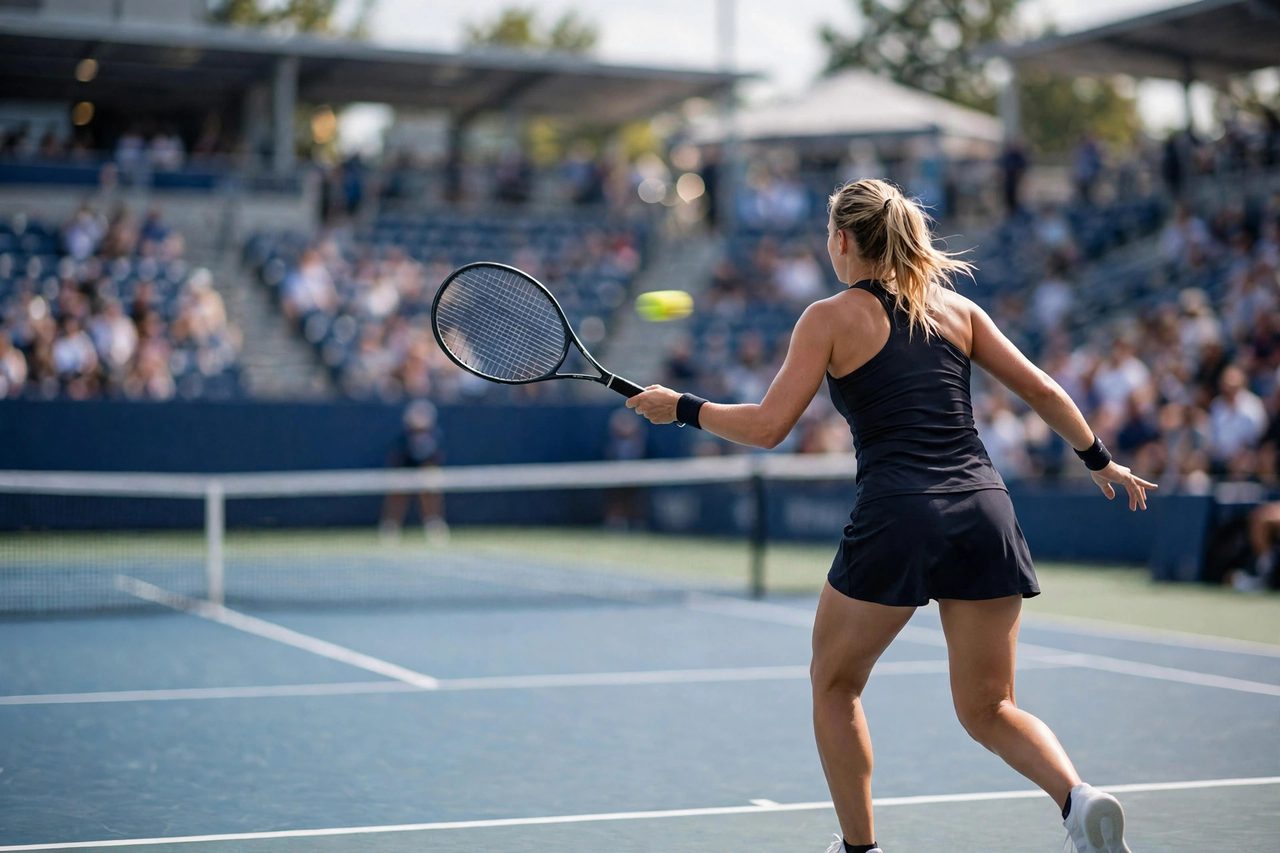
Watch Aryna Sabalenka hit a tennis ball and you understand her whole career in about two seconds. The serve is huge. The forehand is huge. The intent is simple: hit it hard, hit it early, and make the other player deal with it.
For 99 straight weeks, nobody in women’s tennis dealt with it better than she did. Sabalenka held the world No. 1 ranking — the top spot in the women’s game, decided by ranking points earned over the past year — from late 2024 until this September, when Elena Rybakina ended her run by beating her in the US Open final. She is now No. 2, and she arrives at the season-ending WTA Finals this week with something still to prove.
The making
Sabalenka was born on May 5, 1998, in Minsk, the capital of Belarus. She picked up a racquet at six, almost by chance — a visit to the local courts turned into a career. She was not a child star. Her first years on tour were a slow climb, built on power that was obvious and control that was not.
Her first WTA title came in 2018, in New Haven. The big breakthrough took longer. In January 2023, she won her first Grand Slam — the four biggest tournaments in tennis, the Australian Open, Roland-Garros, Wimbledon and the US Open — beating Rybakina in the Australian Open final. By September that year, after reaching the US Open final, she was world No. 1 for the first time.
Then came the run that defined her. In 2024 she defended her Australian Open title without dropping a single set, then won the US Open in New York. She finished that year as the year-end No. 1, the player with the most ranking points when the season closed. In 2025 she did it again, defending her US Open crown by beating Amanda Anisimova in the final and ending the year on top for a second straight season.
The career numbers now read like a hall-of-fame case in progress: 24 singles titles, four Grand Slams (two Australian Opens, two US Opens), and 11 WTA 1000 titles. A WTA 1000 is one of the big tour events just below the Grand Slams, and winning 11 of them puts her among the most successful players of her generation. In total she has spent 107 weeks at No. 1, the tenth-most in the history of women’s tennis.
There is also a doubles chapter that people forget. Sabalenka is a former doubles world No. 1, with six doubles titles, including the 2019 US Open and the 2021 Australian Open, both won with Belgium’s Elise Mertens.
How she plays
Sabalenka’s game is built on power, full stop. Her serve is one of the fastest and most feared on tour, and her forehand — the shot hit on the same side as your dominant hand — can end a rally in one swing. She stands close to the baseline, the line at the back of the court, and takes the ball early, giving her opponent less time to react.
That power used to come with a cost. Early in her career, her serve could fall apart under pressure, with double faults — two missed serves in a row, which lose the point — arriving at the worst moments. Fixing that is the great work of her partnership with coach Anton Dubrov. Dubrov started as her hitting partner, the practice player who trains with a pro every day, and became her head coach in 2020. Together they rebuilt the serve into a weapon and turned raw power into something she can trust in a final.
She is also, by her own admission, an emotional player. She wears her feelings on court — the roars, the frustration, the joy. Fans love her for it. Opponents have to deal with it too.
The 2026 season: so close, twice
This year has been strange for Sabalenka: brilliant, and still somehow unfinished. She won three titles — Brisbane in January, then Indian Wells and Miami back to back in the spring. Winning those two American hard-court events in the same year is called the Sunshine Double, and she became only the fifth woman in history to do it.
But the two biggest matches of her year both went the same way. She reached the Australian Open final and the US Open final, and lost both to Rybakina. The New York defeat cost her the No. 1 ranking after 99 weeks. It also set up the rivalry that now defines the women’s game: two huge hitters, two very different temperaments, meeting in the finals that matter most.
One bright spot this year came off the court. In 2026 Sabalenka was named Laureus World Sportswoman of the Year, the award voted on by a panel of sporting greats.
What’s next
The WTA Finals start on November 8 in Indian Wells, California. The WTA Finals are the season-ending championship, open only to the eight best players of the year. This is Sabalenka’s sixth appearance, and it is the one big title still missing from her collection — she reached the final in 2022 and again in 2025, but has never won it.
Rybakina will be there too, as the new No. 1 and the favourite. For Sabalenka, the week is a chance to answer the question this season has asked of her: can the most powerful player in the game add the one trophy her cabinet lacks, and start the climb back to the top?
She is 28, at her physical peak, with a game built for fast hard courts — exactly the surface in Indian Wells. The power has never been the problem. The next week will show whether the rest of her game is ready to match it.
Profile data via WTA player records and WTA Finals field previews
Related articles
Jannik Sinner: The Quiet Machine Who Took Over Tennis
Jannik Sinner won five Grand Slams and spent 95 weeks as world No. 1 — then a knee injury ended his 2026 season. Here is the rise, the game, and the chase to get the top spot back.
Rybakina's Year-End Crown: Two Slams, 54 Wins, and One Tokyo Afternoon
Elena Rybakina sealed the year-end world No. 1 ranking in Tokyo on Oct 29 — the first Kazakh, male or female, to finish a season on top. How she did it, and what the WTA Finals hold next.
Taylor Fritz: America's Steady No. 1 Hope
Taylor Fritz turned 29 this week, reached a US Open final, and has spent years as the most reliable American man on tour. This is the story of a career built on steadiness, not noise.