
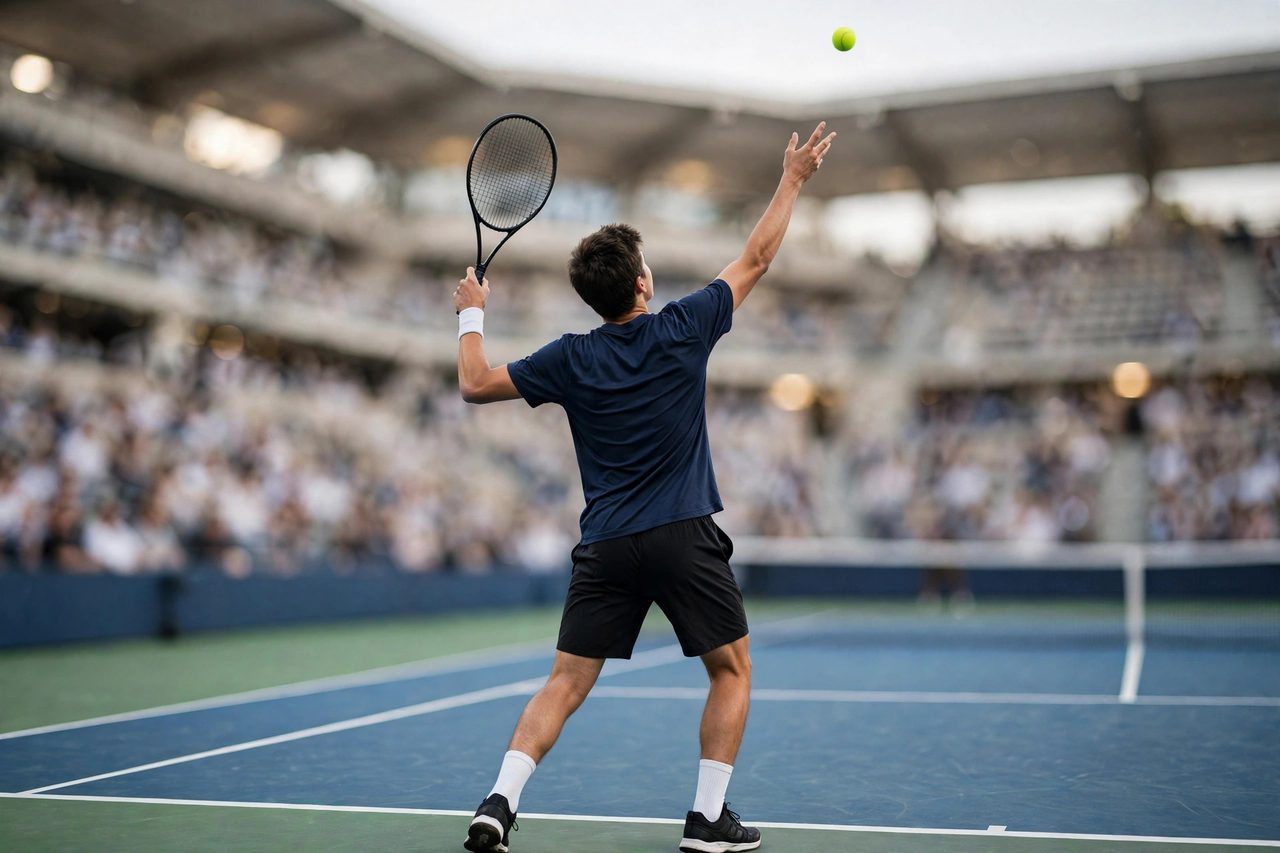
Ben Shelton is hard to miss. He is 1.93 metres tall, left-handed, and serves so fast that opponents sometimes barely move before the ball is past them. He celebrates big points with a phone-call gesture, as if to say: call me when you can handle this. At 24 years old, he is already one of the most exciting players in men’s tennis.
His rise was unusually fast. Most top players spend years as juniors travelling the world. Shelton took a different road, through American college tennis, and still reached the world’s top 10 within about two years of turning professional. That is rare, and it tells you a lot about his talent.
A tennis family
Shelton was born on 9 October 2002 in Atlanta, Georgia, and grew up in Gainesville, Florida. Tennis runs in his family. His father Bryan was a professional player who later became a successful college coach, and his mother Lisa also played college tennis. His coach today is still his father, which is unusual at the top level but clearly works for them.
As a kid, Shelton actually preferred American football. He played as a quarterback, the player who throws the ball and leads the attack. He only decided to focus on tennis at around the age of 12. That late start might explain his style: he plays tennis like an athlete first and a technician second, all power and energy.
He went to the University of Florida, where his father coached the team, known as the Florida Gators. In 2021, as a first-year student, he helped the Gators win their first-ever national team title. The next year he went one better, winning the 2022 NCAA singles championship. The NCAA is the organisation that runs American college sport, and its singles title is the biggest prize in the college game. That win convinced him he was ready for the professional tour.
The breakthrough years
Shelton turned professional in 2022 and made his ATP Tour debut at the Atlanta Open that summer. The ATP Tour is the men’s professional circuit, the weekly series of tournaments where the top players compete. Within months he had won three Challenger titles. A Challenger is a lower-level professional event, one step below the main tour, and winning three of them so quickly showed he was ready for bigger stages.
The big breakthrough came in 2023. At the Australian Open, only his second Grand Slam, he reached the quarter-finals. A Grand Slam is one of the four biggest tournaments in tennis. Then at the US Open later that year, he went even further, reaching the semi-finals. He became the youngest American man to reach the US Open semi-finals since Michael Chang in 1992. He also won his first tour title that year, an ATP 500 event in Tokyo. An ATP 500 is a mid-level tour tournament, a step below the Masters 1000 events.
In 2024 he added a second title, on clay in Houston. Then 2025 brought his biggest win so far: his first Masters 1000 title in Toronto. A Masters 1000 is a tournament one level below the Grand Slams, and winning one puts you in elite company. He also reached the Australian Open semi-finals in 2025 and the Wimbledon quarter-finals, both times losing to the eventual champion Jannik Sinner. In total he has won three ATP singles titles, and his career-high ranking is inside the world’s top 10.
What makes him dangerous
The serve is the obvious weapon. Shelton regularly serves at more than 220 kilometres per hour, and his left-handed angle makes it even harder to return. A left-hander’s serve naturally swings away from a right-handed opponent’s backhand, and Shelton uses that again and again. At the 2023 US Open he served two aces at 149 miles per hour in a single game against Tommy Paul. An ace is a serve that the opponent does not touch at all.
But he is more than a serve. His forehand, the shot hit on the same side as his racquet hand, is explosive, and he loves to attack from the baseline, the back line of the court. He is not afraid to come forward to the net either, and his energy lifts crowds. That matters. Tennis crowds feed off players who show emotion, and Shelton gives them plenty.
There are still things to improve. His return of serve, the shot played back against an opponent’s serve, can be inconsistent, and his clay-court game is still developing. The best players punish any weakness, and Shelton’s rivals know that his second serve is the place to attack. How he handles those details will decide whether he becomes a Grand Slam champion or stays a very good player who never quite wins the biggest prize.
What comes next
Shelton is still only 24, and in tennis terms that is young for a top player. He has already played a starring role in Basel this week, winning a marathon first-round match against fellow American Aleksandar Kovacevic in three tiebreaks. A tiebreak is the short extra game used when a set reaches 6-6.
The next step is clear: turn semi-finals into finals, and finals into titles. He has the weapons, the confidence and the crowd behind him. If the consistency catches up with the talent, Ben Shelton will not just be one of the most exciting players in tennis. He will be one of the best.
Related articles
Jannik Sinner: The Quiet Machine Who Took Over Tennis
Jannik Sinner won five Grand Slams and spent 95 weeks as world No. 1 — then a knee injury ended his 2026 season. Here is the rise, the game, and the chase to get the top spot back.
Aryna Sabalenka: The Power Player Who Ruled Women's Tennis for 99 Weeks
Aryna Sabalenka spent 99 straight weeks as world No. 1, won four Grand Slams, and hits the ball harder than almost anyone in the game. Now, as No. 2, she heads to the WTA Finals chasing one missing trophy.
Rybakina's Year-End Crown: Two Slams, 54 Wins, and One Tokyo Afternoon
Elena Rybakina sealed the year-end world No. 1 ranking in Tokyo on Oct 29 — the first Kazakh, male or female, to finish a season on top. How she did it, and what the WTA Finals hold next.