
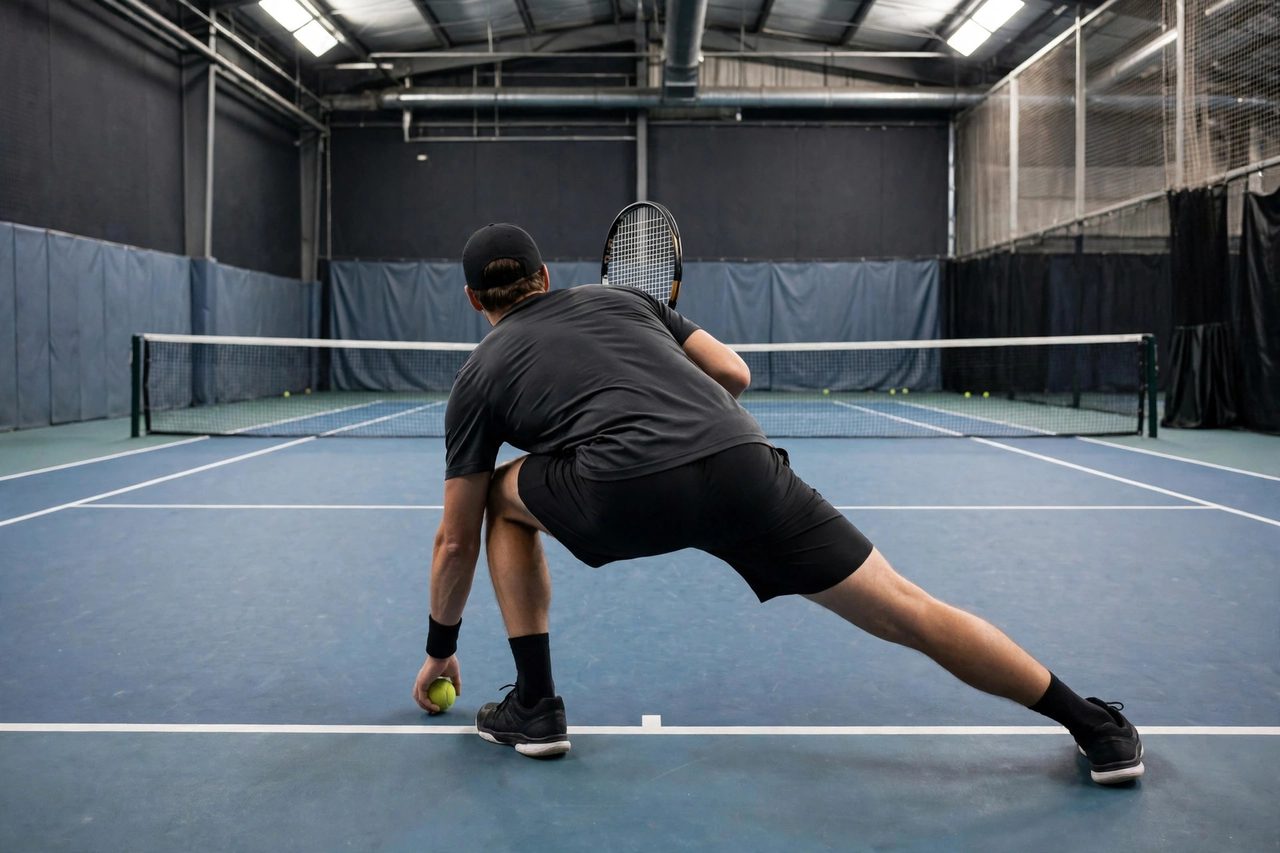
Holger Rune knows what it feels like to have tennis taken away. For almost a year, the Danish star could not play the sport he had built his life around. On Monday in Basel, he took a big step towards getting it back.
Rune beat Quentin Halys 6-4, 6-7(2), 7-6(5) in the first round of the Swiss Indoors. It was his first win on the main tour since October 2025, and it came after one of the hardest injuries in sport.
The injury that stopped everything
Rune ruptured his Achilles tendon during the Stockholm Open semi-final against Ugo Humbert in October 2025. The Achilles tendon is the thick cord that joins the calf muscle to the heel. A rupture is a full tear. It needs surgery, and then months of slow rehab. Rehab is the long process of rebuilding strength and movement, step by step.
Rune had surgery soon after the injury, and his season was over in an instant. He was 22 years old, a former world No. 4, and one of the most exciting young players in the game. Suddenly, he could not even walk normally, let alone sprint, stop, and change direction on a tennis court.
The timing made it worse. The injury kept him out for nearly 11 months. He missed the whole 2026 season up to September, including all four Grand Slams. The Grand Slams are the four biggest tournaments in tennis: the Australian Open, the French Open, Wimbledon, and the US Open. Missing all four in one year is a huge hole in any player’s career.
A knee problem also slowed his return at one stage, and he decided not to rush back for the US Open in New York. He said later that he wanted to come back ready to last four or five sets, not just to play a couple of rounds and hope. That patience was hard, but it was smart.
The long way back
Rune’s return began in September 2026, playing for Denmark in the Davis Cup. The Davis Cup is the men’s team competition, where players represent their country. Playing at home, in front of Danish fans, Rune won both of his singles matches, including one against former world No. 3 Grigor Dimitrov. Denmark’s win sent them into the 2027 qualifiers.
Those wins mattered. They proved his body could handle real matches again. But tour tennis is a different test. In Tokyo, his first tour event back, he lost in the first round to Kyrian Jacquet 6-3, 6-1. In Shanghai, he won the first set against Daniel Altmaier 6-1, then lost 1-6, 7-6(5), 6-4. The tennis was there in patches. The match toughness was not yet back.
That is normal after a long injury. Fitness is not just running. It is trusting your body again. Every sprint to a wide ball, every sudden stop, every jump for a smash asks the same question: will this hold? A player has to answer that question hundreds of times in a match before the doubt fades.
Basel helped. Rune survived 32 aces from Halys, saved all five break points he faced, and won a deciding tiebreak that nearly slipped away. A break point is a chance to win your opponent’s service game. Saving all five, in a match that lasted two hours and 40 minutes, showed that his legs and his nerve both held up.
What kind of player is Rune?
Before the injury, Rune was known as one of the fiercest competitors of his generation. He won the Paris Masters in 2022 as a teenager, beating Novak Djokovic in the final. He reached world No. 4 in 2023. He plays with huge energy, chases every ball, and loves a fight.
That style is also why the comeback is so demanding. Rune’s game is built on speed, intensity, and long rallies. He cannot play at half speed and still be himself. He has to rebuild the engine first, then the results will follow.
His ranking has fallen sharply during his absence, because ranking points expire when a player does not defend them. That means tougher draws and fewer protected spots. Rune has said the ranking is secondary for now. His priority is to rebuild his form, match by match.
What comes next
Rune will not become his old self in one week. That is not how comebacks work. There will be tired legs, lost matches, and days when the timing is off. But Basel was proof of something important: he can still win a long, tense tour match, against a big server, on a fast indoor court, when it matters.
The goal for the rest of 2026 is simple. Play matches. Stay healthy. Build towards 2027 with a body he trusts and a game that feels like his again. If he does that, the ranking will take care of itself.
Rune is 23 years old. He has time. What he lost was a year. What he showed in Basel was that he has not lost the thing that made him special in the first place: the will to fight for every point, even when his body has given him every reason to doubt.
Related articles
Jannik Sinner: The Quiet Machine Who Took Over Tennis
Jannik Sinner won five Grand Slams and spent 95 weeks as world No. 1 — then a knee injury ended his 2026 season. Here is the rise, the game, and the chase to get the top spot back.
Aryna Sabalenka: The Power Player Who Ruled Women's Tennis for 99 Weeks
Aryna Sabalenka spent 99 straight weeks as world No. 1, won four Grand Slams, and hits the ball harder than almost anyone in the game. Now, as No. 2, she heads to the WTA Finals chasing one missing trophy.
Rybakina's Year-End Crown: Two Slams, 54 Wins, and One Tokyo Afternoon
Elena Rybakina sealed the year-end world No. 1 ranking in Tokyo on Oct 29 — the first Kazakh, male or female, to finish a season on top. How she did it, and what the WTA Finals hold next.