
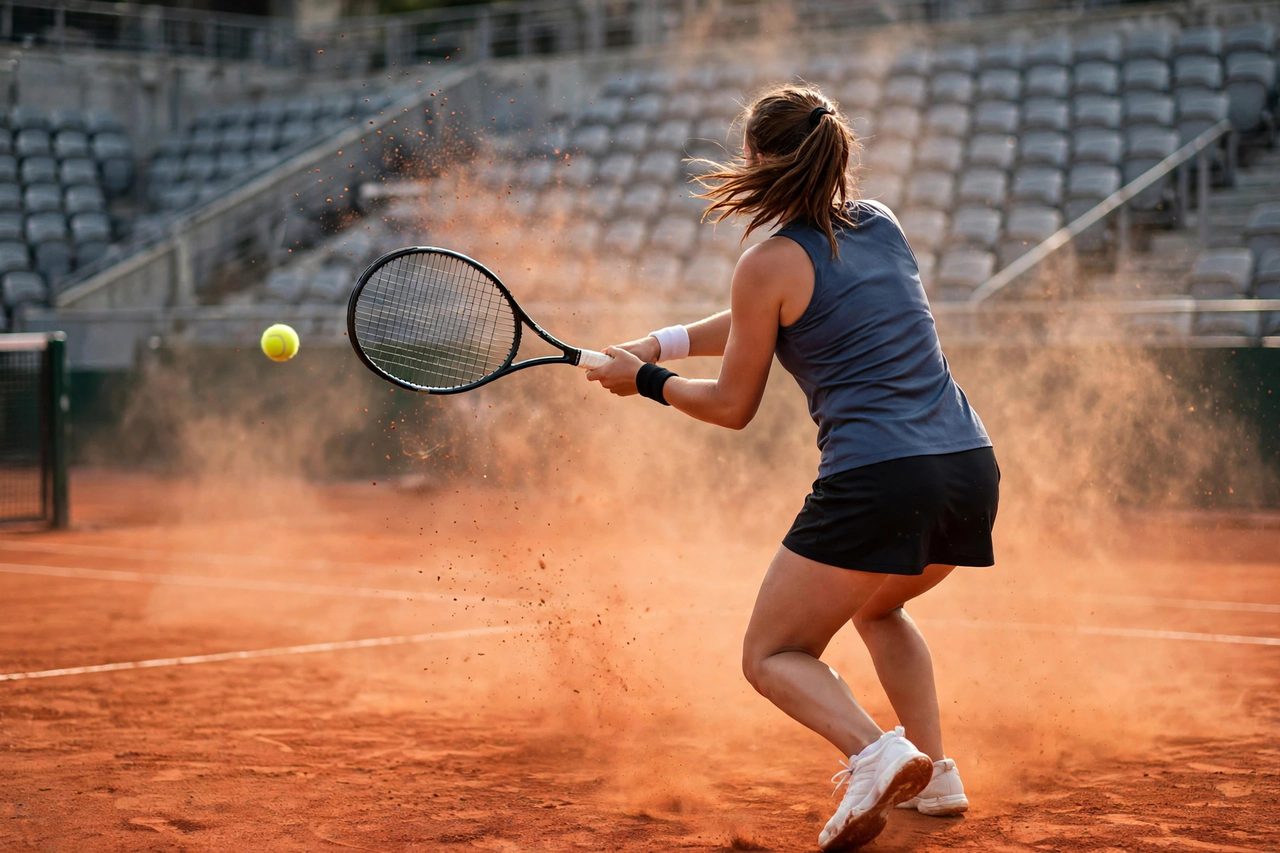
Nobody in tennis arrives quietly anymore. There is always a highlight reel, a management company, a narrative. Mirra Andreeva managed it anyway — or almost. By the time most people had formed a proper opinion of her, she was already lifting the Coupe Suzanne-Lenglen.
The numbers say she’s arrived. World No. 3 since October 2026 — a career high. Six career singles titles. And at Roland-Garros this spring, the Russian became the youngest champion of the Parisian Grand Slam in the 21st century, at 19, beating Maja Chwalinska in the final. Her 2026 record sits at 50 wins and 16 defeats, with titles in Adelaide and Linz alongside Paris and finals in Madrid and Beijing, where she lost to Qinwen Zheng in the China Open showpiece.
The making
Andreeva was born on April 29, 2007, in Krasnoyarsk, Siberia — which makes her one of the few elite players to come out of Russia’s far east rather than its Moscow tennis academies. Tennis runs in the family: her older sister Erika is also a professional, and the family moved to Europe to give both daughters their shot, with Mirra spending her formative years at the Elite Tennis Center in Cannes, France.
She turned pro in 2022, and the first act was a blur. At 16, in the summer of 2023, she came through qualifying at Wimbledon and reached the second week. The following spring, still 17, she made the Roland-Garros semifinals — the youngest player to reach a Grand Slam last four since Martina Hingis in 1997. Then came 2025: two WTA 1000 titles, Dubai and Indian Wells, and a top-10 debut. And this year, the grand slam — literally. Her Paris title was built on a spring where she won Linz, made the Madrid final, and then swept through the Paris draw with a clay-court record that finished at a staggering 22-3 on the season.
How she plays
Andreeva is a tactical baseliner in an era of first-strike bombers, and that’s precisely what makes her interesting. Right-handed with a rock-solid two-handed backhand, she reads the court like a chess player: early ball, smart geometry, impossible defense. The numbers back up the eye test — this season she wins 58% of her second-serve return points and 47% of pressure points on return, and she breaks first serves at a 41% clip. Against power, she doesn’t out-hit; she out-thinks, and when the rally tightens, her 13-8 record in deciding sets says she usually out-lasts too.
Coaching matters here. Since 2024 she has been guided by Conchita Martínez, the 1994 Wimbledon champion, who has given her game its shape and her temperament its edge. The partnership survived the hardest test a prodigy faces — the season after the breakthrough — and came out stronger.
The head and the heart
What endears her to people who watch closely is the honesty. After the US Open this year she spoke openly about the stress of being 19 and carrying expectations — about feeling super demanding of herself, about learning not to overthink, to treat each tournament lightly, to, as she put it, just “chill, enjoy.” That candor is rare in a sport that trains its stars to speak in clichés, and it hints at the real work happening behind the ranking: the management of expectation as a skill, learned at the same speed as the drop shot.
There is also the doubles chapter, easy to forget: Olympic silver in Paris 2024, and a career-high No. 12 in the doubles rankings last September. She plays the team game well too — the court sense translates everywhere.
What’s next
The honest answer is the top spot, and soon. She’s third, 19 years old, already a major champion with a game that works on every surface — the 88% clay win rate is the headline, but 27 hard-court wins this season say the rest of the tour has problems too. Her great vulnerability so far is the matchup against the very best: 3-7 against the top 10 this year. But she has time, and in tennis, time is the one asset the prodigies always undervalue.
The tour has had its share of teenage phenoms who burned out. Andreeva, coached by a former champion, playing a thinking game, talking honestly about the pressure — she looks built to last. The question isn’t whether she becomes No. 1. It’s what she does with it.
Profile data via Roland-Garros player records and WTA season statistics
Related articles
Jannik Sinner: The Quiet Machine Who Took Over Tennis
Jannik Sinner won five Grand Slams and spent 95 weeks as world No. 1 — then a knee injury ended his 2026 season. Here is the rise, the game, and the chase to get the top spot back.
Aryna Sabalenka: The Power Player Who Ruled Women's Tennis for 99 Weeks
Aryna Sabalenka spent 99 straight weeks as world No. 1, won four Grand Slams, and hits the ball harder than almost anyone in the game. Now, as No. 2, she heads to the WTA Finals chasing one missing trophy.
Rybakina's Year-End Crown: Two Slams, 54 Wins, and One Tokyo Afternoon
Elena Rybakina sealed the year-end world No. 1 ranking in Tokyo on Oct 29 — the first Kazakh, male or female, to finish a season on top. How she did it, and what the WTA Finals hold next.